


Leasing Farmland for Solar in Germany: Tax Overview
Anyone leasing arable land for photovoltaics trades a few hundred euros of agricultural rent for a multiple of it — and moves into a different tax world at the same time. Taxing the rent itself is the easy part. The expensive surprises arise elsewhere: with the property tax that jumps from Grundsteuer A to B, and with land held in agricultural business assets, where the change of use can disclose hidden reserves. This guide sorts out the five relevant taxes and shows which points should be settled before you sign.
"Check in 10 seconds — no email, no callback"
Key Takeaways
- The rent is taxable income — as income from letting and leasing (§ 21 EStG) for private assets, as a business receipt within agricultural business assets.
- The biggest pitfall sits in business assets: if the change of use results in a withdrawal, hidden reserves have to be disclosed and taxed.
- Leasing is in principle exempt from VAT (§ 4 no. 12 UStG); an option to tax under § 9 UStG is available because the tenant is an entrepreneur.
- With conventional ground-mounted solar the land usually moves from Grundsteuer A to Grundsteuer B (property tax). The owner remains liable — who bears it is settled by the lease.
- Trade tax (Gewerbesteuer) does not normally arise on a pure lease.
Important note
This article offers general orientation and does not constitute tax advice. German tax law for agricultural and forestry land is highly case-dependent, and several of the points described here — the treatment of business assets on a change of use above all — are not assessed uniformly by practitioners. Have your specific case reviewed by a Steuerberater (German tax adviser) before you sign a lease. After signing, the course is set.
Which taxes matter in a solar lease
Five taxes are relevant. Four of them can usually be sorted out quickly; one is the real point to check.
| Tax | What generally applies | How critical |
|---|---|---|
| Income tax | Rent is taxable — § 21 EStG for private assets, a business receipt in business assets | unavoidable but plannable |
| Attribution of the land for income tax | Business assets stay business assets; a withdrawal discloses hidden reserves | the real point to check |
| VAT | Leasing exempt (§ 4 no. 12 UStG), option to tax available | a structuring question |
| Grundsteuer (property tax) | Switch from Grundsteuer A to B with ground-mounted solar | can be handled in the lease |
| Gewerbesteuer (trade tax) | A pure lease is asset management, no trade tax | usually uncritical |
Inheritance and gift tax joins the list as soon as a handover to the next generation is on the horizon.
Income tax: where the lease payments land
The rent is taxable in every case. The only question is which category of income it falls into — and that depends on whether the land belongs to your private assets or to agricultural and forestry business assets.
Private assets: the rent regularly counts as income from letting and leasing under § 21 EStG. You declare it in the Anlage V of your return; it is taxed at your personal income tax rate. Expenses connected with the lease — notary and advisory fees, surveying, property tax you bear yourself — are deductible as Werbungskosten (income-related expenses).
Agricultural business assets: if the land belongs to an operating or leased-out agricultural or forestry business, the rent is a business receipt and feeds into income from agriculture and forestry. Everything in the next section then applies on top.
This distinction is not a formality. It decides the category of income, the treatment of hidden reserves and, indirectly, the inheritance tax position. If you are not certain which type of assets your land sits in, that is the first question for your tax adviser.
One-off payments and payments in advance
Some contracts provide for a one-off payment at the start — an option or security fee, say — or an advance covering several years. As a rule the cash-flow principle applies: income is taxed in the year it is received. For income from a grant of use exceeding five years that is paid in advance, § 11 (1) sentence 3 EStG offers an election to spread the amount evenly over the period the advance covers. Given the long terms of a solar lease this can noticeably flatten the progression — whether and how it applies in your case belongs in the tax return, and therefore in professional hands.
The key point: business assets and hidden reserves
This is the risk most landowners underestimate — and the reason a solar lease without a prior tax review is a bad idea.
Arable land belonging to a farm usually sits in the books at a very low book value, often for decades. The market value is far above it. The difference is the hidden reserves (stille Reserven): a gain that has never been taxed because it has never been realised.
As long as the land stays in business assets, those reserves stay untaxed. If the land is withdrawn (Entnahme), however, the withdrawal counts as realisation: the difference between book value and the value at the time of withdrawal has to be taxed. The unpleasant part is that no cash arrives with which to pay that tax.
Leasing on its own does not remove land from business assets — leased business land can remain business assets. The critical question is the change of use: once arable farming becomes energy generation and the land is attributed to Grundvermögen (general real property) for tax purposes, the question of a withdrawal arises afresh. Whether it does depends among other things on how the contract is drafted, on an agreed obligation to dismantle and recultivate, on the size of the affected part of the parcel and on the continued use of the business. This question is not answered uniformly in the professional literature.
What that means in practice:
- Establish before signing whether your land sits in business or private assets.
- Have it checked whether the planned contract can trigger a withdrawal — and what order of magnitude of hidden reserves is at stake.
- Make sure dismantling and recultivation are cleanly covered by the contract. That is not only protection for the end of the term, it is also a relevant circumstance for tax.
- Factor a possible tax charge into your comparison of lease offers before you pick a developer.
Which clauses matter in detail is set out in the guide to the Photovoltaic Lease Agreement.
Betriebsaufgabe or Verpachtungsbetrieb
Anyone giving up not just a part of the land but the entire business faces a second fork in the road. Tax law grants the lessor a choice: declare a cessation of business (Betriebsaufgabe) or continue the business as a leased-out business (Verpachtungsbetrieb).
On cessation, all land moves into private assets and every hidden reserve is taxed in a single year. In return, the law provides, subject to conditions such as having reached the age of 55 or permanent occupational disability, a tax-free allowance and a reduced rate under §§ 16 and 34 EStG. With a Verpachtungsbetrieb everything stays business assets, the rent remains income from agriculture and forestry, and taxation of the reserves is deferred, if need be until the next generation.
Important since 2011 is the rule in § 16 (3b) EStG: a business counts as ceased only once the owner expressly declares the cessation or the tax office becomes aware of the circumstances. An accidental cessation through merely leasing out is thereby largely excluded. The flip side: anyone who wants to use the cessation deliberately, for instance to exploit the allowance and reduced rate in a low-income year, must actively declare it. Which option is more favourable depends on age, other income and the planned succession, and belongs in an advisory meeting rather than a rule of thumb.
VAT: exempt — with an option to tax
Letting and leasing of land is exempt from VAT under § 4 no. 12 (a) UStG. For the standard case that means you do not charge the developer VAT, and the agreed rent is the amount that reaches you. An exception applies to the extent that operating equipment (Betriebsvorrichtungen) is leased along with the land — the exemption does not cover that part.
The interesting bit is the option under § 9 UStG: anyone leasing to an entrepreneur for their business may waive the exemption and opt for VAT liability. A solar park operator is an entrepreneur and generates electricity turnover that does not preclude input VAT recovery, so the conditions are typically met.
The benefit: you can recover input VAT on your own costs, for example on advisory, surveying or connection invoices. The price: you add VAT to the tenant's invoice (which they normally recover as input VAT, so it is a pass-through item for them), but you take on ongoing filing obligations and tie yourself in for a long period. Whether it pays off is pure arithmetic and depends on how much input VAT actually arises on your side. For farmers there is a further point: leasing does not fall under the flat-rate scheme for agricultural and forestry businesses, and the small-business rule of § 19 UStG has its own limits and consequences.
Easement, option fee and real estate transfer tax
Three building blocks of a solar lease are often forgotten for tax because they sit alongside the actual rent.
- Easement (Dienstbarkeit). Developers usually secure their rights through a limited personal easement in the land register, sometimes against a separate fee. For VAT, the granting of easements falls under § 4 no. 12 (c) UStG and is therefore exempt just like the rent. For income tax the fee is taxable and, where the grant of use is limited in time, is generally treated like rent.
- Option fee (Optionsvergütung). The fee for reserving the land exclusively during the development phase is taxable, even if the park is never built. In private assets it is attributed, depending on the arrangement, to income from letting and leasing or to other income under § 22 no. 3 EStG; in business assets it is a business receipt.
- Real estate transfer tax (Grunderwerbsteuer). It does not arise. Neither the lease nor the easement is an acquisition within the meaning of § 1 GrEStG. It is different only on a sale of the land or the creation of a heritable building right; there the acquirer bears the tax.
Grundsteuer: from Grundsteuer A to Grundsteuer B
Property tax is the tax that reacts most visibly to a solar lease — and the one most often overlooked.
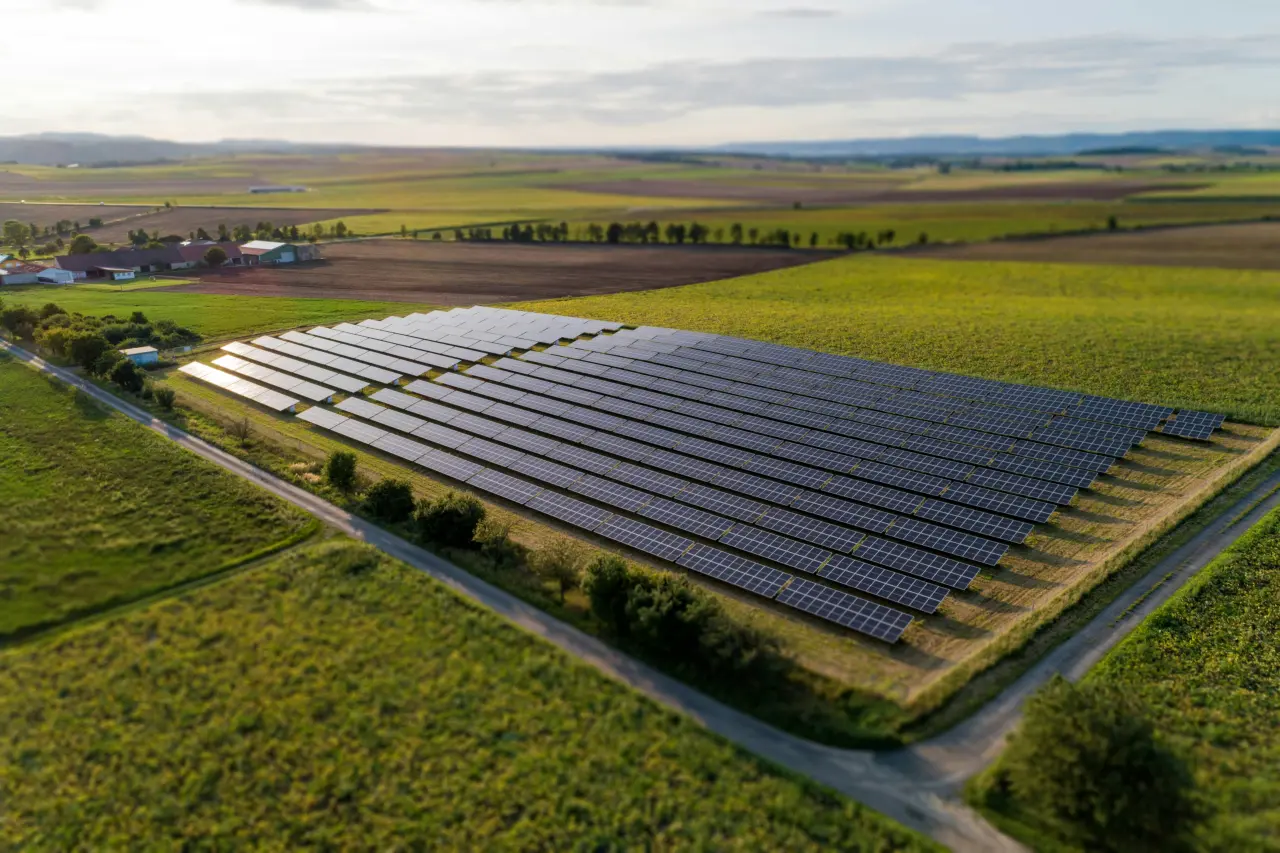
Land in agricultural use is valued as agricultural and forestry property and falls under Grundsteuer A. Once a conventional ground-mounted photovoltaic plant stands on it, it is generally attributed to Grundvermögen (general real property) and therefore assessed under Grundsteuer B. The burden rises noticeably — the actual amount depends on the valuation result and on your municipality's multiplier (Hebesatz) and cannot be stated as a flat figure.
Two exceptions matter:
- Agri-photovoltaics: land carrying agri-PV installations of category I or II under DIN SPEC 91434 stays within agricultural and forestry assets — the agricultural primary use continues. Grundsteuer A therefore still applies.
- State law: since the property tax reform, Grundsteuer is in part a matter for the federal states. Bavaria has created a rule in Art. 9 (3) BayGrStG under which previously farmed land built over with a ground-mounted plant can continue to be taxed under Grundsteuer A subject to conditions — in particular a contractual obligation to dismantle with subsequent continuation of agricultural use. On current knowledge no other federal state has a comparable general rule. Check the current position for your own state rather than relying on a rule of thumb.
Who pays the property tax when land is leased out?
It is worth separating two things here.
The person liable is whoever the property is attributed to for tax purposes — in practice the owner. The municipality's assessment notice comes to you, regardless of who uses the land.
Who bears it economically is whoever the lease names. In solar leases it is standard, and appropriate, to pass the property tax — and in particular the increase caused by the changed use — on to the tenant: the extra burden arises from their installation, after all. Make sure the clause does not merely mention property tax but expressly covers future increases and revaluations. Without such a provision you pay the difference out of your rent.
The position is the same in a classic agricultural lease, incidentally: the owner is liable and passing it on is a matter of contract. It simply goes unnoticed there, because Grundsteuer A is comparatively low.
Trade tax: normally not an issue
Leasing out land is not running a business, it is managing assets. A pure lease is private asset management, and trade tax does not arise on it in principle. The solar park is operated by the tenant; the commercial income from selling electricity arises with them, not with you.
Exceptions are conceivable but are individual cases:
- Betriebsaufspaltung (business split) — where you lease the land to a company that you also control. The lease can then become a commercial activity.
- Commercially characterised or commercially active partnerships as lessor — there the legal form, or an activity carried on alongside, colours the income.
- Commercial property trading (gewerblicher Grundstückshandel) — where a volume of purchases and sales going beyond private asset management is added to the leasing.
All three are constellations you spot once you know them — and that you should not create by accident. If any of them is conceivable in your structure, have it reviewed up front.
Inheritance and gift tax: not losing the relief
Agricultural and forestry assets may qualify for relief on inheritance and gifts under §§ 13a and 13b ErbStG. That relief hangs on a privileged use — and a solar lease is precisely what changes it.
Two effects are possible. Land handed to third parties for use may be classified as administrative assets (Verwaltungsvermögen), although counter-exceptions exist for agricultural and forestry land. And if a ground-mounted plant moves the land into Grundvermögen, the basis for relief on that parcel may fall away. With agri-PV of category I or II, by contrast, the attribution to agricultural and forestry assets is preserved.
Where a farm handover or a gift is due in the next few years, this is not a side issue — it can determine the order of the steps. The guide Inherited Farmland in Germany: Inheritance Tax, Lease or Sell covers valuation, allowances and retention periods in detail.
Community of heirs, pension fund and accident insurance
If the land belongs to a community of heirs (Erbengemeinschaft), the co-heirs can only lease jointly, and all of them become parties to the contract. The lease income is determined uniformly and separately for the community and attributed to each co-heir according to their share. If the business was inherited with relief under §§ 13a and 13b ErbStG, a change of use within the retention period can trigger retroactive taxation. That question belongs before the partition of the estate, not after it.
Outside tax law but economically closely related is the agricultural social insurance. Since 2019 handing over the farm (Hofabgabe) is no longer a condition for the old-age pension. Compulsory insurance in the Landwirtschaftliche Alterskasse (farmers' pension fund) and the farmers' health fund, however, depends on whether the business reaches the minimum size. Anyone leasing a substantial part of their land for photovoltaics can drop below that threshold, whereupon contribution obligations and benefit entitlements can change. Contributions to the agricultural accident insurance fund likewise follow the area farmed. Anyone wanting certainty here asks the SVLFG before signing.
What to settle before you sign
- Establish the asset attribution — does the land sit in private assets or in agricultural business assets? Everything else follows from this.
- Have the hidden reserves quantified — book value against market value, and whether the planned contract can trigger a withdrawal.
- Check the property tax clause — does the contract pass Grundsteuer, including future increases and revaluations, on to the tenant?
- Dismantling and recultivation — contractually binding and secured; relevant for tax in more than one respect.
- Decide on VAT — do the arithmetic on the § 9 UStG option instead of leaving it unconsidered.
- Think ahead on succession — is a handover due before the lease expires?
- Involve a tax adviser — before signing, not after. The fee is a fraction of what an overlooked withdrawal can cost.
Whether your land is suitable for a solar project at all can be checked free of charge and without registration. The check shows grid connection, protected areas and eligibility in around ten seconds — a solid basis before you invest time in tax questions.
For realistic rent levels see Photovoltaic Lease Prices 2026; for the overall process see Lease Land for a Solar Park, and for arable land specifically Lease Arable Land for Solar.
Frequently Asked Questions on tax in a solar lease
This article provides a general overview and does not constitute tax advice. German tax law for agricultural and forestry land is case-dependent; the income tax treatment of business assets on a change of use, the property tax attribution under state law and the inheritance tax reliefs in particular hinge on the specific contractual and asset structure. The legal position and the tax authorities' view can change. Have your case reviewed by a Steuerberater (German tax adviser) before making any decision.