


Agri-PV 2026: Agrivoltaic Systems in Germany Explained — System Types, Lease Rates, Subsidies and What Landowners Actually Receive
Agri-photovoltaics (agri-PV, also called agrivoltaics) means that farming continues on the same land while solar modules above or between the crops generate electricity. Agriculture remains the primary use — that is what DIN SPEC 91434 requires, and the German Renewable Energy Sources Act (EEG), the farm subsidy rules and planning law all rely on it. For you as a landowner, the numbers look like this: an agri-PV system typically pays €1,000 to €3,000 rent per hectare per year, roughly two to seven times the arable rent, but less than a classic solar park at €3,000 to €5,000. In return, the land stays in agricultural use and, as a rule, remains eligible for farm subsidies. This guide explains which system types exist, which crops work underneath, how agri-PV is actually subsidised in 2026 — more has shifted there than most guides online reflect — and when dual use pays off for your land.
"Check in 10 seconds — no email, no callback"
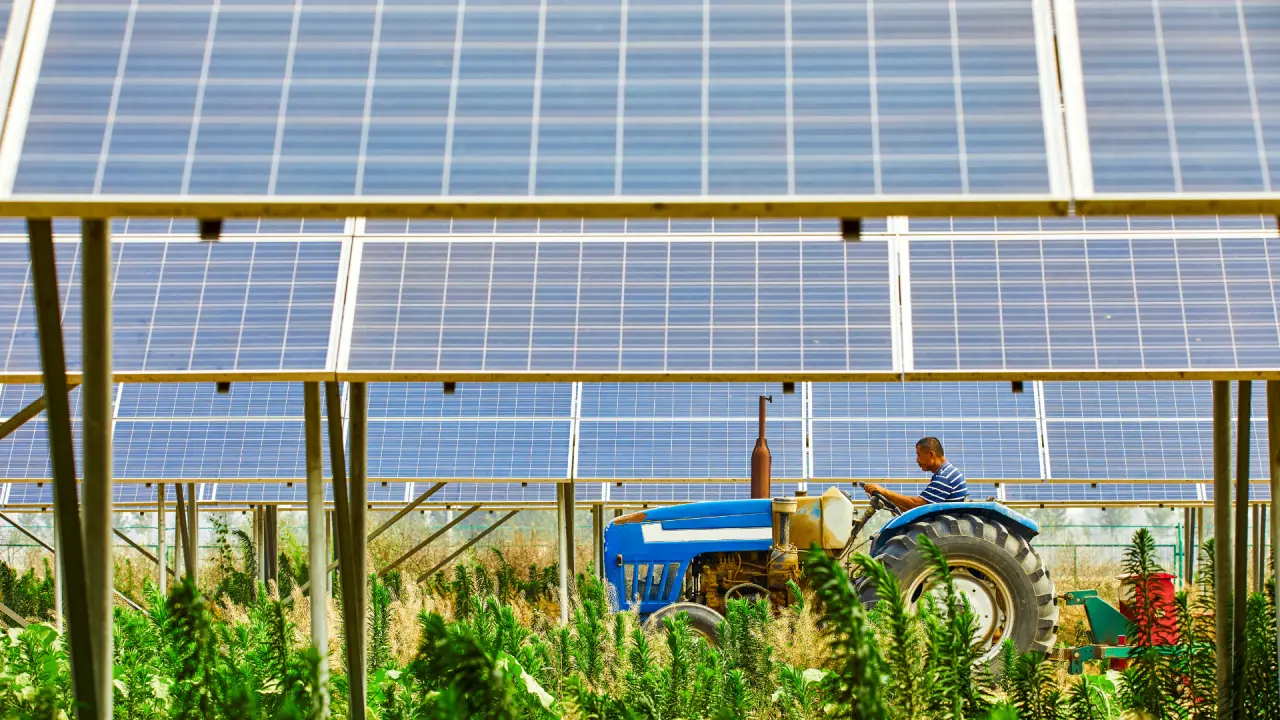
Key facts at a glance
Farming remains the primary use. Under DIN SPEC 91434, racks and edge strips may take at most 10 % (elevated, Category I) or 15 % (ground-level, Category II) of the land, and the agricultural yield must reach at least 66 % of a reference area.
Rent: €1,000–3,000/ha per year — less than a classic solar park, because only about 300 to 700 kWp fit on a hectare instead of roughly 1,000 kWp, and the mounting structure costs more. In return, farming continues.
The EEG support that applies in 2026 is not the one written in the law. The dedicated sub-segment for special solar installations (1,200 MW in 2026) and the ceiling price of up to 9.5 ct/kWh have been waiting for EU state-aid approval since May 2024 (§ 101 EEG). Until then, the old bonus applies: +0.5 ct/kWh for systems with at least 2.10 m clearance height. The cabinet draft of the EEG 2027 of 29 July 2026 would scrap the sub-segment entirely and stay at 0.5 ct/kWh.
The 85 % rule for direct payments no longer exists. Since the 2025 application year, only the land actually lost is deducted — at most 15 %, less for slim systems (4th amending ordinance to the GAPDZV, the German CAP direct payments ordinance).
Planning law: privileged up to 25,000 m² at a farmstead, one system per farmstead or operating site (§ 35 (1) no. 9 BauGB, Federal Building Code). Anything larger needs a development plan (Bebauungsplan) like any solar park.
For landowners, agri-PV is usually the second-best option — sensible if the municipality does not want a classic solar park, the land is indispensable to the farm, or special crops need protection. The free area check shows whether the higher-paying option is possible on your land.
What is agri-PV? Four definitions that must fit together
Colloquially, any solar installation on a field is "agri-PV". Legally, that is wrong, and this is where most misunderstandings between landowners and project developers start. A system is only agri-PV if it simultaneously meets four sets of rules, each answering a different question:
| Question | Rules | Requirement |
|---|---|---|
| Is the system technically an agri-PV system? | DIN SPEC 91434:2021-05 (arable, permanent crops, grassland cut for fodder) and DIN SPEC 91492:2024-06 (livestock) | Farming as primary use, land loss at most 10 % or 15 %, at least 66 % of the reference yield, agricultural use concept before construction |
| Does the electricity receive EEG support as a "special solar installation"? | § 37 (1) no. 3 (a)–(c) EEG and the determinations of the Federal Network Agency (BNetzA) under § 85c EEG | Arable land with simultaneous crop cultivation, permanent or multi-year crops, or permanent grassland (not in Natura 2000 sites); no peat soil |
| Does the land remain eligible for direct payments? | § 12 (4) no. 6 and (5) GAPDZV | Cultivation with customary farm machinery remains possible, land loss under DIN SPEC 91434 at most 15 % |
| May it be built without a development plan? | § 35 (1) no. 9 BauGB | Spatial and functional link to a farm, at most 25,000 m² footprint, one system per farmstead or operating site |
Important in practice: DIN SPEC 91434 is not a legal norm but a private specification. It becomes binding because the EEG determinations and the direct payments ordinance refer to it. The Federal Network Agency has issued two determinations — one for arable, permanent-crop and car-park areas (as of 1 October 2021) and one for grassland and drained peat soils (as of 1 July 2023) — which are based on DIN SPEC "to a large extent, but not entirely", as the German Solar Industry Association (BSW-Solar) notes in its statement on the EEG 2027. The interpretation questions still open in 2026 are covered in the guide Agri-PV: legal situation 2026 for permits and subsidies.
DIN SPEC 91434 in detail: categories, land loss and the 66 per cent rule
DIN SPEC 91434 ("Agri-photovoltaic systems — Requirements for primary agricultural use", May 2021 edition) divides agri-PV systems by height into two categories and by use into four sub-categories:
| Category I: elevated with clearance height (farming under the modules) | Category II: ground-level mounting (farming between the module rows) | |
|---|---|---|
| A — Permanent and multi-year crops | 1A: fruit, berries, vines, hops | 2A: fruit, berries, vines, hops |
| B — Annual and overwintering crops | 1B: arable crops, vegetables, ley grassland, forage crops | 2B: arable crops, vegetables, ley grassland, forage crops |
| C — Permanent grassland, cut | 1C: intensive and extensive grassland | 2C: intensive and extensive grassland |
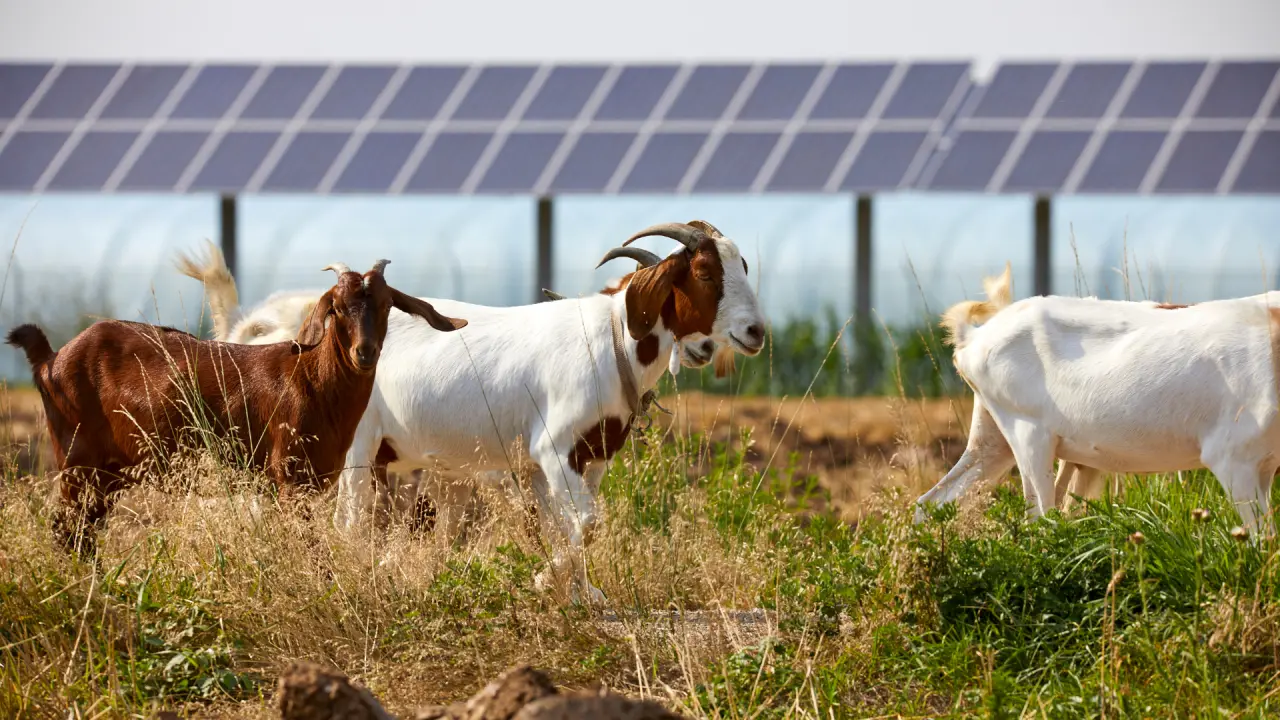
| D — Permanent grassland, grazed | 1D: permanent pasture, rotational grazing | 2D: permanent pasture, rotational grazing |
| Clearance height | at least 2.10 m | below that; the land under the modules then generally counts as unusable |
| Maximum land loss | 10 % of the total project area | 15 % of the total project area |
Three requirements apply to both categories:
- Limited land loss. The land that can no longer be farmed — posts, foundations, inverters, tracks, strips under low modules that cannot be worked — must stay within these limits.
- At least 66 % of the reference yield. After construction, the agricultural yield on the project area must reach at least two thirds of what the same land would produce without the system. The reference yield is derived from several years of farm data or from regional averages in official statistics.
- Agricultural use concept before construction. It describes the crop and rotation, working widths and clearance heights of the machinery, light availability and distribution, and the proof of the 66 % rule. The subsidy body, the agricultural authority and often the permitting authority ask for this concept.
Livestock — categories 1D and 2D — is expressly excluded from DIN SPEC 91434. Since June 2024 it has been covered by DIN SPEC 91492 ("Agri-photovoltaic systems — Requirements for livestock farming"). Among other things, it sets requirements for light conditions, stocking density, lying and retreat areas and protecting the system from the animals. The widespread claim that keeping chickens or pigs under modules is fundamentally not agri-PV cannot be traced to the standards: the example list in DIN SPEC 91434 names poultry and pigs alongside cattle, sheep and goats for permanent pasture. The sticking point lies elsewhere — in the direct payments. If livestock destroys the sward, farming activity is generally deemed "severely restricted" under § 12 (3) GAPDZV, and the land loses its eligibility. Anyone planning poultry under modules should therefore clarify it with the agricultural authority in advance.
System types: what stands above and between the crops
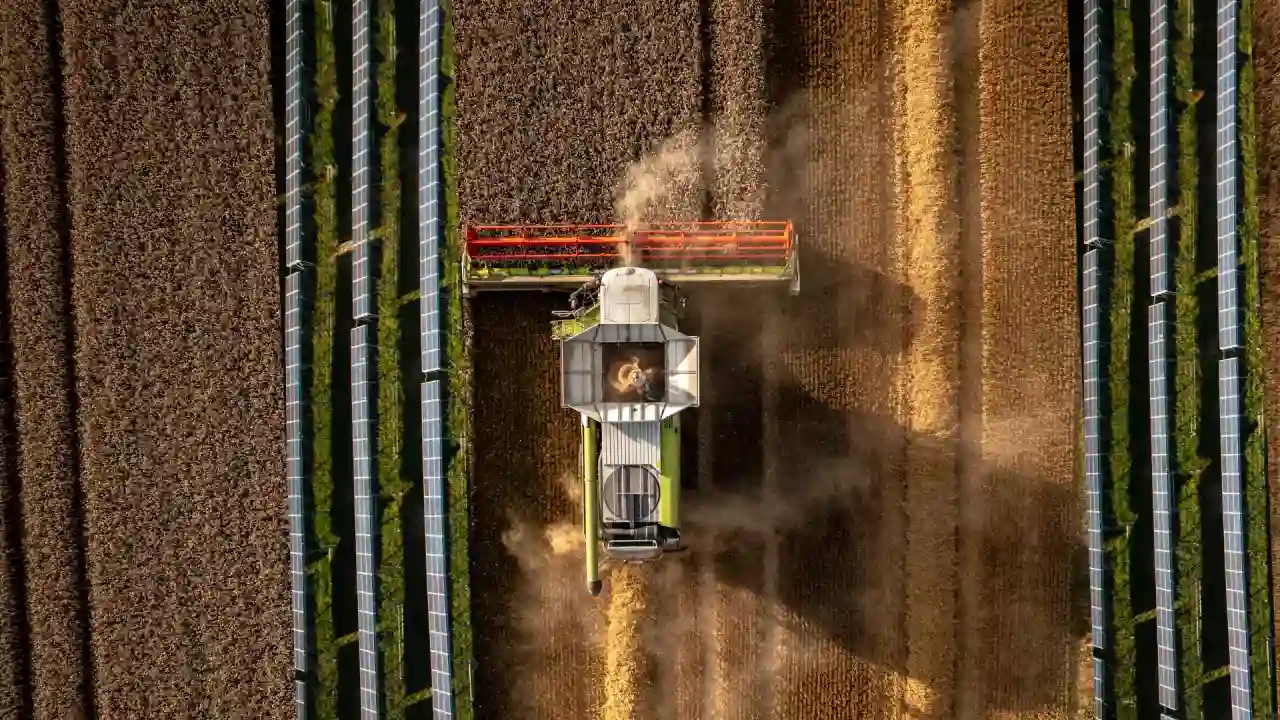
Four designs have become established in practice. They differ above all in how much capacity fits on a hectare — and that is exactly what determines the rent later on.
| Design | DIN category | Typical use | Capacity per hectare | Levelised cost of electricity |
|---|---|---|---|---|
| Elevated over arable crops (4–5 m and more) | I | Cereals, potatoes, vegetables — passable by combine harvester | approx. 600 kWp | avg. 8.15 ct/kWh |
| Elevated over special crops (approx. 3 m) | I | Berries, pome and stone fruit, vines, hops | approx. 700 kWp | — |
| Ground-level or vertical (bifacial modules, east-west) with wide row spacing | II | Grassland, mowing, arable farming between rows | approx. 300 kWp (grassland) | avg. 6.03 ct/kWh |
| Single-axis trackers with wide row spacing | I or II, depending on height | Arable, grassland | depends on row spacing | — |
| For comparison: classic ground-mounted system | — | no farming | approx. 1,000 kWp | — |
Capacity densities and levelised costs: example calculations by Fraunhofer ISE in its guide "Agrivoltaics: Opportunities for Agriculture and the Energy Transition", February 2024 edition; cost values are averages over a 20-year lifetime, not market prices.
Elevated systems (Category I)
The modules stand three to five metres high, in hop growing even more than seven metres, so that tractors, sprayers and combine harvesters can work underneath. The best-known German example is the research installation of the Heggelbach farm community on Lake Constance (2016): modules more than five metres high, 9.5 metres between rows with a row width of 3.4 metres, farmed even with large machinery. The price of this design lies in the mounting structure: Fraunhofer ISE assumes an average of €372 per kWp for it, compared with €76 for a classic ground-mounted system. The resulting levelised cost of electricity is around 50 % above that of a normal solar park.
Over special crops, this design is most convincing economically, because the modules take over a job the farm would otherwise pay a lot for: they replace hail nets, rain or foil covers and protect berries and fruit from sunburn and heavy rain.
Vertical systems (Category II)
Bifacial modules stand vertically in rows, usually facing east-west, and generate electricity on both sides — with peaks in the morning and afternoon instead of at midday, when all south-facing parks feed in at once. Strips several metres wide remain between the rows for mowing, grazing or arable farming. One of the best-known examples is in Donaueschingen-Aasen: around 11,000 bifacial modules, 4.1 MWp, officially opened on 13 October 2020. Land loss is low, and so is the capacity per hectare — for ground-level rows on grassland, Fraunhofer ISE calculates with about 300 kWp per hectare.
Tracking systems
Single-axis trackers turn the modules with the sun and can be rotated "out of the way" when needed, for example for farm work or during heavy rain. How close the rows may stand, how high the rotation axis should be and how much land remains workable can be tried out in the following configurator:
Interactive: configure tracker rows yourself
Adjust row pitch, axis height, module configuration and sun position, and watch how the land balance, clear spacing and ground clearance respond.
Simplified model: 2.382 m × 1.134 m modules, ideal tracking without backtracking. Only the post strip counts as non-farmable (85 % rule as per DIN SPEC 91434).
Legally, this design has not yet been cleanly classified: which "clearance height" counts for a tracker — for instance the lower edge of the rotation axis — is not yet regulated in the EEG. In its statement on the EEG 2027 (as of 3 September 2026), BSW-Solar explicitly calls for clarification. For you as a landowner, this means: with a tracker concept, the developer should explain how eligibility for support is secured.
Which crops work — and what research shows about yields
DIN SPEC requires at least 66 % of the reference yield. In the German test installations, yields were usually well above that, but they vary with the weather:
- Heggelbach 2017 (normal year): yields under the modules stayed above 80 % of the reference area; land-use efficiency — harvest plus electricity on the same land — rose to around 160 %.
- Heggelbach 2018 (hot summer): partial shading increased the harvest. For potatoes, 103 % of the reference yield and 83 % of the electricity yield of a pure solar area combined — a land-use efficiency of 186 %.
- Wet years: here, shade can hurt. Fraunhofer ISE reports yield losses of up to 20 % for the Heggelbach crops in wet growing seasons.
This results in a rough suitability list:
| Suitability | Crops | Why |
|---|---|---|
| Very good | Berries, pome and stone fruit, vines, hops, many vegetables, lettuce, spinach | shade-tolerant; modules replace hail and rain protection |
| Good | Grassland (cut), forage crops, clover-grass, potatoes | low light requirements; shade reduces drought stress |
| Possible, with a discount | Wheat, barley, rye, rapeseed | more light-demanding; needs high mounting or wide rows and large clearance widths |
| Difficult | Maize and other very light-demanding crops | react clearly to shading |
| Livestock | Sheep, cattle, goats; poultry with reservations | sheep work under almost any system; cattle need Category I or robust vertical rows; for poultry, clarify sward and subsidy eligibility |
Two effects are often forgotten in guides. First: module edges concentrate rain. Without drainage, erosion channels form under the drip line; good concepts collect the water and use it for irrigation. Second: machinery and posts only get along if the planning starts from the machinery. Working widths of mower and sprayer, turning circles at the headland and clearance height belong in the use concept before a single post is set.
Support in 2026: what the EEG says — and what is actually applied
This is the biggest difference between this guide and most texts online. Since the Solar Package I of May 2024, the EEG contains a generous support model for agri-PV. To this day, it is not applied.
Large systems from 1 MW: auctions
Agri-PV systems of one megawatt and above — like any solar park — need an award in the Federal Network Agency's auctions for first-segment solar installations. There they count as special solar installations (besondere Solaranlagen, § 37 (1) no. 3 EEG). Since May 2024, the law has provided two advantages for them:
- a dedicated sub-segment in which special solar installations are awarded first — up to 1,200 MW in 2026, 1,500 MW in 2027, 2,000 MW in 2028 (§ 37d EEG); agri-PV only counts there with a clearance height of at least 2.10 m, or at least 0.80 m for purely vertical systems;
- a dedicated ceiling price of up to 9.5 ct/kWh (§ 37b (2) EEG) instead of 5.90 ct/kWh in the normal segment.
Both rules are subject to a state-aid approval reservation: § 101 (1) EEG only permits their application after approval by the European Commission — and that is still missing. Until then, the old technology bonus from § 38b (1) sentences 2 and 3 EEG in the version of 15 May 2024 expressly applies: elevated agri-PV with at least 2.10 m clearance height receives a mark-up on the award value, which has tapered from 1.2 ct/kWh (awards in 2023) to 0.5 ct/kWh for awards in 2026 to 2028. Vertical and ground-level systems do not receive this bonus.
In practice, agri-PV projects therefore compete with classic solar parks in the normal ground-mounted segment — and do better there than expected: in the 1 March 2026 round, 59 awards totalling 439 MW went to special solar installations, a record and almost one fifth of the awarded volume (Federal Network Agency, 12 May 2026). The whole round was twice oversubscribed; the volume-weighted average award value was 4.94 ct/kWh, and 4.79 ct/kWh in July 2026. What these cent amounts mean for rent is calculated in the guide Feed-in tariffs 2026.
Small systems up to 1 MW: statutory value without an auction
Below one megawatt there is no auction. For systems commissioned between 1 August 2026 and 31 January 2027, the applicable value for ground-mounted and other installations is 6.19 ct/kWh up to 100 kWp and 6.59 ct/kWh up to 1,000 kWp under direct marketing. Here, too, the law provides an agri-PV mark-up (§ 48 (1b) EEG, 2024: 2.5 ct/kWh) — and it, too, is on the list in § 101 EEG and will not be applied until EU approval.
An order of magnitude often overlooked in farm-based projects: at Fraunhofer ISE's capacity densities, 1 MWp corresponds arithmetically to about 1.4 ha of agri-PV over berries, 1.7 ha over arable crops and 3.3 ha of grassland with ground-level or vertical rows. A privileged farm system of up to 25,000 m² can therefore lie above or below the auction threshold depending on its design — and that decides the entire support model.
What is planned from 2027
The federal cabinet adopted the draft of a new EEG on 29 July 2026; parliamentary deliberation has been under way since September 2026. For agri-PV, the draft provides for scrapping the never-applied sub-segment and its dedicated ceiling price and replacing them with a bonus of 0.5 ct/kWh for agri-PV and peatland PV — essentially enshrining today's status quo. BSW-Solar criticises this as a "clear-cut", calls for keeping the sub-segment with rising volumes and, alternatively, a bonus of at least 2 ct/kWh. The association also points out that the current state-aid approval of the EEG as a whole expires at the end of 2026. How the process ends is open. For ongoing lease negotiations, this means: do not calculate with the 9.5 ct/kWh still found in some offers and guides.
Direct payments: the 85 per cent rule is history
The second point on which many sources are out of date. Up to and including 2024, land with an agri-PV system was counted at a flat 85 % for CAP direct payments. The Fourth Ordinance amending the CAP Direct Payments Ordinance (BGBl. 2024 I no. 396, adopted by the Bundesrat on 22 November 2024) lifted this restriction from the 2025 application year. The agriculture ministry of Baden-Württemberg summarises the effect: depending on the determined extent of the impairment of agricultural use on the land in question, "a deduction of less than 15 % of the area and thus higher support is also possible".
The rules in detail:
- Principle: land with solar installations counts as mainly used for non-agricultural purposes and is not eligible — unless the farmer proves that it is an agri-PV system (§ 12 (4) no. 6 GAPDZV).
- An agri-PV system within the meaning of the ordinance does not rule out cultivation with customary agricultural methods, machinery and equipment and reduces the usable agricultural area under DIN SPEC 91434 by at most 15 % (§ 12 (5) GAPDZV).
- Since 2025, the area actually usable is counted — so a slim vertical system with low land loss now earns more than before.
- Classic solar park: the land drops out of support entirely.
An important detail for lessors: the direct payment goes to the farmer who works the land, not to the owner. If your land is leased to a farmer, it is the farmer who benefits from continued eligibility — which is an argument for bringing them into the project early instead of taking the land away from them.
Planning law: privileged up to 25,000 m² — everything else via a development plan
Since 2023, agri-PV systems have been privileged in the outdoor area (Außenbereich), but within narrow limits. § 35 (1) no. 9 BauGB covers projects that serve "the use of solar radiation energy by special solar installations within the meaning of § 48 (1) sentence 1 no. 5 (a), (b) or (c) of the Renewable Energy Sources Act" — that is, agri-PV on arable land, with permanent crops or on permanent grassland — under three conditions:
- "the project is spatially and functionally linked to a holding under number 1 or 2" — an agricultural, forestry or horticultural business,
- "the footprint of the special solar installation does not exceed 25,000 square metres",
- "only one installation is operated per farmstead or operating site".
A building permit then suffices; the development-plan procedure is not needed. Even a privileged system, however, needs the municipality's consent (Einvernehmen, § 36 BauGB), and it must be dismantled once the use is permanently given up — § 35 (5) BauGB requires an undertaking to that effect, which the authority secures, for example, by a public-law easement (Baulast). In some federal states, privileged solar installations are now even exempt from a building permit; the overview of all 16 state building codes is in the guide Ground-mounted solar approval 2026.
All larger agri-PV systems and all without a link to a farm need a development plan like a classic solar park: resolution to draw up the plan, amendment of the land-use plan, environmental assessment, adoption as a bylaw — typically one to three years. The project developer files and pays. Many municipalities are more open to dual use than to a park that takes the land out of farming for 30 years; in practice, that is often the strongest argument for agri-PV.
What landowners earn: lease, own operation, participation
Rent compared
| Use of the land | Rent per hectare per year | Ratio to arable rent |
|---|---|---|
| Arable land, existing leases (national average) | €407 | 1× |
| Permanent grassland (national average) | €212 | 0.5× |
| Agri-photovoltaics | €1,000–3,000 | 2.5–7× |
| Ground-mounted solar park | €3,000–5,000 | 7–12× |
| Large battery storage (0.5–3 ha, near the grid) | €20,000–30,000 | 50–74× |
Agricultural rents: Federal Statistical Office (Destatis), Agricultural Structure Survey 2023; solar and storage rents: ENLAPA market observation 2026, guide values. Details and all federal states in the guide Lease prices for arable land 2026.
Why agri-PV pays less than a solar park is pure arithmetic: depending on the design, 300 to 700 kWp stand on a hectare instead of about 1,000 kWp, and each kilowatt costs more in mounting structure. Per hectare, the operator therefore has less margin from which to pay rent. Why it still pays a multiple of the agricultural rent: the land generates electricity in addition, without losing its agricultural function.
A worked example with 10 hectares, for orientation and using the ranges above: leased as arable land, the area earns around €4,000 a year at the national average. With an agri-PV system at €2,000 per hectare, about €20,000 of system rent is added while farming continues. A classic solar park at €4,000 per hectare would bring around €40,000, but farming on the land ends for the term. Which option is better for you depends less on the rent difference than on whether the farm needs the land — and on what the municipality and the grid allow on your land in the first place.
Three models
- Leasing to a project developer. The developer plans, permits, finances, builds and operates; you receive the rent, and farming stays with you or your agricultural tenant. The permitting, subsidy and compliance risk lies with the developer.
- Building and operating it yourself. Typical for the privileged farm system of up to 25,000 m². You keep all electricity revenue and can use part of the power on the farm — in Heggelbach, around 40 % of the solar power was used directly on the farm, about 70 % with a 150 kWh battery. In return, you bear investment, permitting effort, grid connection and operating risk over 20 to 30 years.
- Participation. In between are models in which you hold shares in the operating company or part of the rent is performance-based. They mainly pay off if you want to contribute equity without becoming the operator yourself.
When agri-PV is the right choice for landowners
- The municipality rejects classic solar parks but would support dual use.
- The land is indispensable to the farm — fodder base, special crops, existing lease commitments.
- You grow berries, fruit or vines and need protection against hail and heavy rain anyway.
- You want to operate a small farm-based system yourself without a development plan.
In all other cases a classic solar park pays more, and on land near a substation a battery storage system can bring ten times as much — on just a fraction of the area. How that works is explained in the guide Leasing land for large battery storage. The downsides of dual use in detail are covered in the guide Agri-PV disadvantages 2026.
The agri-PV lease: what differs from a solar park
An agri-PV contract has more parties than an ordinary solar lease: the owner, the system operator — and the farmer who continues to work the land. If that is not the owner, there is usually an existing agricultural lease (Landpachtvertrag) that has to be amended or partly terminated; it cannot be ended unilaterally for a solar project. How that works is explained in the guide Terminating an agricultural lease.
In addition to the usual clauses — a term of 20 to 30 years, indexation, a dismantling obligation backed by a bank guarantee, an easement (Grunddienstbarkeit) — an agri-PV contract needs:
- Right and duty to farm: who farms which strips and areas, with which machines, how often? Without actual farming, EEG status and subsidy eligibility are lost.
- Use concept and evidence: who prepares the agricultural use concept, who supplies the ongoing yield evidence, who bears the cost?
- Liability: who is liable if a machine damages a post — and who if modules, cables or maintenance vehicles damage crops or soil?
- Access and construction windows: construction and maintenance outside sowing and harvest, secured passages, soil protection during construction.
- Direct payments and support: a clear allocation of who applies for farm subsidies, and a rule for the case that eligibility is lost.
- Exit scenario: what happens if agri-PV status is withdrawn — conversion to a classic system, rent adjustment, dismantling?
The general contract clauses are explained in the guide Photovoltaic lease agreement. Have every contract reviewed by a lawyer before signing.
Risks you should know
- Subsidy uncertainty: the generous support model of Solar Package I has not been applied for more than two years, and the EEG 2027 draft would scrap it. Projects that only work at 9.5 ct/kWh will not be built.
- Compliance risk: the 66 % rule and the land-loss limit must hold over the entire term. How strictly authorities check is not regulated uniformly across Germany.
- Yield fluctuations: in wet years, shading can noticeably depress the harvest; light-demanding crops are a poor fit.
- Harder farming: posts, headlands and clearance heights change working routines and increase the risk of damage.
- Smaller pool of developers: not every developer builds agri-PV; offers are less often comparable than for a classic park.
- Grid: as with any solar project, free capacity at the grid connection point decides in the end. Without a grid connection, even the best dual use is worthless.
Step by step: is your land suitable for agri-PV?
- Check the hard criteria. Protected areas, flood zones, regional planning, the EEG land catalogue and the distance to the nearest substation decide whether a solar installation is possible at all. The free ENLAPA area check checks this in seconds using official geodata — no email, no callback.
- Check the highest-paying option first. If a classic solar park or battery storage is possible, agri-PV is usually the second choice.
- Define the agricultural use. Which crop will grow under or between the modules, who farms, which machines drive? The design follows from that.
- Clarify the planning route. Farm-based up to 25,000 m² with a link to the holding — or a development plan with the municipality. An early conversation at the town hall shows whether dual use has support.
- Clarify existing agricultural leases. If the land is leased, the farmer must be on board.
- Compare offers. Look at the rent, indexation, dismantling security and how the developer organises the use concept and evidence.
Further reading
- Agri-PV: legal situation 2026 for permits and subsidies — which interpretation questions are still open
- Agri-PV disadvantages 2026 — the honest trade-off against a classic solar park
- Photovoltaic lease prices 2026 — what developers pay for solar land
- Lease prices for arable land 2026 — official agricultural rents in all 16 federal states
- Leasing land for large battery storage — €20,000–30,000/ha on grid-near land
- Ground-mounted solar approval 2026 — privilege, development plan and state building codes
- Feed-in tariffs 2026 — award values and what a hectare earns
- Building a solar park 2026 — the process from land to commissioning
- Photovoltaic lease agreement — term, indexation, dismantling security
- Solar parks and biodiversity — what a solar park can do for biodiversity
- Lease arable land for solar and Lease meadow and grassland for solar — the land types at a glance
Frequently asked questions about agri-PV
Conclusion
In 2026, agri-PV is no longer a technology of the future but an established part of the solar market: almost one fifth of the awards in the March auction went to special solar installations. For landowners, the arithmetic nonetheless stays sober. At €1,000 to €3,000 per hectare, dual use brings a multiple of agricultural rent, but less than a classic solar park — and the generous support model some offers still calculate with has not been applied since May 2024 and is to be dropped entirely with the EEG 2027. On the other hand, direct payments have improved: since 2025, only the actual land loss is deducted. Agri-PV is the right choice when the municipality does not want a classic park, the land must stay in the farm, or special crops need protection.
Whether a classic solar park, battery storage or an agri-PV system is possible on your land is shown in a few seconds by the free ENLAPA area check — no email, no callback. If you then want to know what project developers would pay for your land, you can list it here and obtain lease offers from vetted developers. An overview of all land types is available under Lease land for a solar park.
Sources: Renewable Energy Sources Act (§§ 37, 37b, 37d, 38b, 48, 85c, 101 EEG) in the version in force on 29 September 2026 per gesetze-im-internet.de; § 38b (1) sentences 2 and 3 EEG in the version in force on 15 May 2024 (applicable under § 101 (1) EEG). Federal Building Code (§§ 35, 36 BauGB). CAP Direct Payments Ordinance (§ 12 GAPDZV) and Fourth Ordinance amending the CAP Direct Payments Ordinance (BGBl. 2024 I no. 396), press release of the Baden-Württemberg Ministry for Rural Affairs of 2 December 2024. DIN SPEC 91434:2021-05 "Agri-photovoltaic systems — Requirements for primary agricultural use" and DIN SPEC 91492:2024-06 "Agri-photovoltaic systems — Requirements for livestock farming". Fraunhofer ISE, "Agrivoltaics: Opportunities for Agriculture and the Energy Transition — a guideline for Germany", February 2024 edition (capacity densities, investment and levelised costs, Heggelbach results), and FAQ at agri-pv.org. Federal Network Agency, auctions for first-segment solar installations, bid dates 1 March 2026 (press release of 12 May 2026) and 1 July 2026 (press release of 18 August 2026). German Solar Industry Association (BSW-Solar), statement on the draft Act for a plannable, cost-efficient, grid-compatible and market-oriented expansion of renewable energy in the electricity sector, as of 3 September 2026. Next2Sun, agri-PV system Donaueschingen-Aasen (opened 13 October 2020). Agricultural rents: Federal Statistical Office, Agricultural Structure Survey 2023. Solar, agri-PV and storage rents: ENLAPA market observation 2026, guide values. As of 29 September 2026. This article gives a general overview and does not replace legal or tax advice; have your specific lease reviewed by a lawyer before signing.