


Feed-in Tariffs 2026: Current Rates — and What They Mean for Your Land
Under the German Renewable Energy Sources Act (EEG), the feed-in tariff for new installations commissioned from 1 August 2026 is 7.70 ct/kWh for partial feed-in and 12.22 ct/kWh for full feed-in on a roof (first 10 kWp), and 6.19 ct/kWh for ground-mounted and other systems up to 100 kWp. For a solar park on farmland, however, none of these figures apply: above 1,000 kWp the auctions run by the Bundesnetzagentur (Federal Network Agency) determine the level of support, and there the volume-weighted award value most recently stood at 4.79 ct/kWh. This guide covers both layers — the table values for small systems and the auction market that actually decides what lease a project developer can offer for your hectare. The lease ranges themselves are covered in the guide Photovoltaic Lease Prices 2026.
"Check in 10 seconds — no email, no callback"
The key points at a glance
Rooftop systems from 1 August 2026: 7.70 ct/kWh (partial feed-in) or 12.22 ct/kWh (full feed-in) for the first 10 kWp, tapering above that.
Ground-mounted up to 100 kWp: 6.19 ct/kWh fixed tariff; up to 1,000 kWp, 6.59 ct/kWh as the applicable value in direct marketing.
Solar park above 1,000 kWp: no statutory tariff, but an auction — 2026 award values between 3.99 and 5.10 ct/kWh, most recently averaging 4.79 ct/kWh.
Degression: 1 percent every six months (Section 49 EEG), next step on 1 February 2027.
Negative power prices: since the Solarspitzengesetz (25 February 2025) no support in quarter-hours with a negative exchange price, offset by an extension of the support period at the end.
EEG 2027: government draft of 29 July 2026 — end of the fixed feed-in tariff, 14 GW of ground-mounted auctions per year, 70 percent cap at the grid connection point. Not yet in force.
The rates from 1 August 2026 at a glance
The semi-annual degression of one percent took effect again on 1 August 2026. For installations commissioned between 1 August 2026 and 31 January 2027, these applicable values (anzulegende Werte) apply:
| System type and size | Partial feed-in | Full feed-in |
|---|---|---|
| Rooftop system up to 10 kWp | 7.70 ct/kWh | 12.22 ct/kWh |
| Rooftop system up to 40 kWp | 6.66 ct/kWh | 10.24 ct/kWh |
| Rooftop system up to 100 kWp | 5.44 ct/kWh | 10.24 ct/kWh |
| Ground-mounted / other system up to 100 kWp | 6.19 ct/kWh | — |
| Ground-mounted / other system up to 1,000 kWp (direct marketing) | 6.59 ct/kWh | — |
The values apply pro rata: on a 20 kWp rooftop system with partial feed-in, the first 10 kWp receive 7.70 ct/kWh and the remainder 6.66 ct/kWh. The rate applicable at commissioning is fixed for the year of commissioning plus 20 full calendar years — later amendments do not change it. The next degression step of around one percent follows on 1 February 2027.
Why your solar park does not get a "feed-in tariff"
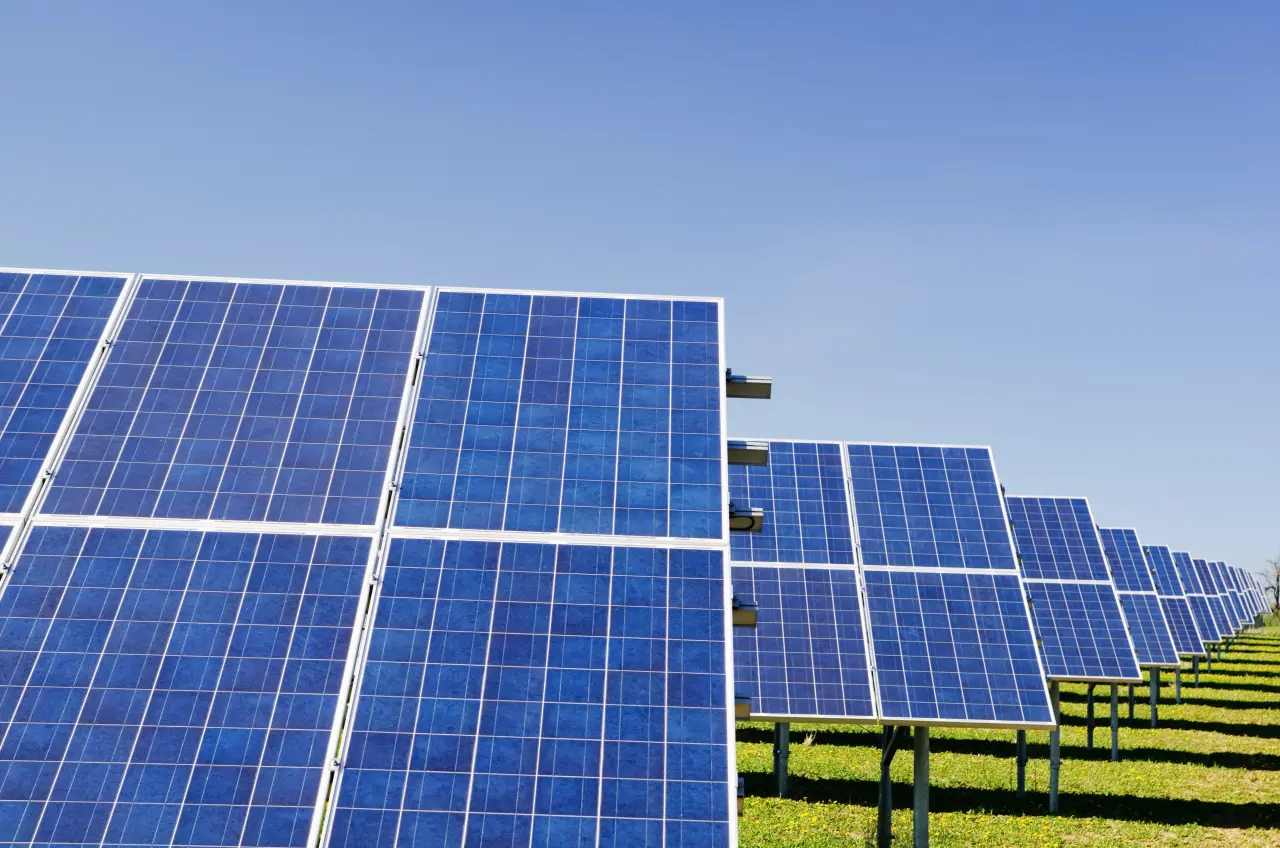
For owners of agricultural land, the decisive figure is not in the table above at all. The reason is the auction requirement: ground-mounted installations with more than 1,000 kWp of installed capacity only receive EEG support if the operator wins an award in a Bundesnetzagentur auction. Since roughly 1 MWp — that is, 1,000 kWp — fits on one hectare as a rule of thumb, practically every solar park from about one hectare upwards is subject to auction. What applies to your land is therefore not the table value but the award value of the round in which the project bid.
On top of that, direct marketing is mandatory from 100 kW of installed capacity. The operator then sells the electricity on the exchange and receives the difference between the market value and the applicable value as a market premium. The anzulegender Wert (applicable value) is therefore not a fixed amount per kilowatt-hour but a ceiling inside the market premium model — a distinction many guides gloss over.
The 2026 auctions: the market that sets your lease
The Bundesnetzagentur auctions support volumes for ground-mounted installations several times a year. Whoever names the lowest bid value wins the award. The two rounds evaluated so far in 2026:
| Bid date | Auction volume | Bids submitted | Award values | Volume-weighted average |
|---|---|---|---|---|
| 1 March 2026 | 2,295 MW | 532 bids / 4,622 MW | 3.99–5.10 ct/kWh | 4.94 ct/kWh |
| 1 July 2026 | 2,135 MW | 401 bids / 3,170 MW | 4.38–4.97 ct/kWh | 4.79 ct/kWh |
Both rounds were heavily oversubscribed — in March the bids amounted to roughly double the volume on offer. The ceiling price, the maximum permitted bid, was 5.90 ct/kWh for the July round; not a single award came anywhere near it. Regionally, the July awards went above all to Bavaria (429 MW), Baden-Württemberg (266 MW), Rhineland-Palatinate (239 MW), North Rhine-Westphalia (233 MW) and Lower Saxony (225 MW).
Two things follow for you as an owner. First, competition for awards is fierce and developers calculate tightly — a lease demand far above the market level can simply price a project out of the auction. Second, the awarded capacity is spread across the whole country, not just the south. How the eligible land categories (benachteiligte Gebiete, or less-favoured areas, and the strips along motorways and railway lines) decide whether your land can be bid at all is explained in the guide Solar Package 1: what applies to your land in 2026.
From award value to lease: the order of magnitude
The award value is the ceiling on what a project can earn per kilowatt-hour. Out of that sum, the modules, mounting structure, inverters, grid connection, operations, insurance, decommissioning reserve, financing, the voluntary municipal share under Section 6 EEG (up to 0.2 ct/kWh) — and your lease — all have to be paid.
As an order of magnitude: roughly 1 MWp fits on one hectare, and 1 MWp generates about 1 gigawatt-hour of electricity a year in Germany. At an award value of 4.79 ct/kWh that is around 48,000 euros of electricity revenue per hectare per year. A market-standard lease of 3,000 to 5,000 euros per hectare therefore equals roughly 6 to 10 percent of the electricity revenue. The calculation is deliberately rough — irradiation, module technology, packing density and the area actually permitted shift it in both directions — but it explains two things immediately: why the lease cannot rise indefinitely, and why the distance to the grid connection point weighs so heavily. Every kilometre of connection cable comes out of the same sum that funds your lease.
For orientation on how far lease levels diverge by land use:
| Type of use | Lease per hectare and year (2026) |
|---|---|
| Arable lease (agricultural) | around €350 |
| Agri-photovoltaics | €1,000–3,000 |
| Classic ground-mounted PV | €3,000–5,000 (premium up to ~€5,500) |
| Battery storage (BESS) | €20,000–30,000 (usually only 0.5–3 ha needed) |
The full ranges and price drivers are explained in the guides Photovoltaic Lease Prices 2026 and Lease Prices for Arable Land 2026. A battery storage site earns a multiple per hectare precisely because it does not depend on an award value per kilowatt-hour generated but on the price difference between charging and discharging — see the guide Leasing Land for Large Battery Storage.
Negative power prices: the rule that really bites in 2026
Since the Solarspitzengesetz, in force since 25 February 2025, newly commissioned installations receive no EEG support in any quarter-hour with a negative exchange power price (Section 51 EEG). The threshold was lowered drastically: previously the rule only applied from 400 kW of installed capacity, now from 2 kW — though between 2 and 100 kW only where a smart metering system is installed. The payment is not simply cancelled: the lost periods are made up at the end of the 20-year support period (Section 51a EEG). Installations connected before 25 February 2025 keep the previous legal position (Section 100 (46) EEG).
The hour counts show how relevant this is: there were around 301 hours with negative exchange power prices in 2023, 457 in 2024 and a record 573 hours in 2025 — and market observers expect another record year in 2026. The solar market value swings accordingly: the annual value was 4.508 ct/kWh in 2025, while the monthly value stood at 11.019 ct/kWh in January 2026 and at only 1.317 ct/kWh in April 2026.
For you as a lessor this is not a technicality but a concrete negotiating argument: a revenue share without an agreed minimum rent passes exactly this volatility through to your income. The operator carries the market risk anyway — it should not hit your lease as well. How a minimum rent, an indexation clause and the other protective clauses are drafted is set out in the guide Photovoltaic Lease Contract.
EEG 2027: what the government draft says (and does not yet mandate)
The federal cabinet adopted the government draft of the EEG 2027 on 29 July 2026. The Bundestag began its deliberations in September 2026 and EU state aid approval is still outstanding. Until the act is promulgated, the EEG 2023 as amended by Solarpaket I (in force since 16 May 2024) and the Solarspitzengesetz continues to apply. Everything below is therefore expressly a draft:
- End of the fixed feed-in tariff for new installations; the transition leads into direct marketing, with a time-limited transitional payment planned for small systems.
- 14 gigawatts of auction volume per year for ground-mounted installations until 2032 — a substantial expansion on today.
- Removal of the rooftop quota: the existing rule that at least half of the auction volume must go to rooftop systems (Section 4 sentence 2 EEG 2023) is to be repealed. That shifts volume structurally towards ground-mounted solar.
- 70 percent cap: for ground-mounted PV, feed-in capacity at the grid connection point is to be limited to 70 percent of installed capacity — intended to ease grid expansion.
- Agri-PV and moor-PV are to receive a technology-specific bonus of 0.5 ct/kWh on the applicable value (Section 38a EEG 2027 draft).
- New biodiversity requirements for ground-mounted projects, plus 500 MW a year of "resilience auctions" using qualitative criteria such as supply chain and cyber security.
- Procedure: the two-stage process of award and later payment entitlement is dropped; projects are to be registered in the Marktstammdatenregister (market master data register) before bidding.
What does this mean for an owner weighing options today? In the short term, little: existing awards and running contracts are unaffected, and anyone commissioned by the end of 2026 keeps their terms for 20 years. In the medium term two points matter — and they point in opposite directions. The expansion to 14 GW a year plus the removal of the rooftop quota means more ground-mounted land in demand, hence more competition for suitable plots. The 70 percent cap works the other way: it reduces the marketable volume per project and with it the room for lease payments. What the net effect will be cannot be quantified honestly today — anyone who quantifies it for you is guessing. For agri-PV land, the 0.5 ct bonus would be a clear improvement; the legal framework there is covered in the guide Agri-PV permitting and support 2026.
Degression, term and what comes after 20 years
Degression has run semi-annually at one percent since February 2024 (Section 49 EEG) rather than monthly as before. That makes planning calmer but lowers the rates steadily: a 10 kWp rooftop system started at 8.1 ct/kWh for partial feed-in in January 2024; today it is 7.70 ct/kWh.
When the 20-year support period ends, post-support installations (Ü20-Anlagen) fall under the statutory follow-on tariff of Section 25 EEG: the annual solar market value less a marketing deduction. The annual solar market value was 4.508 ct/kWh in 2025 and the deduction 0.72 ct/kWh; for 2026 it is 0.23 ct/kWh. Solarpaket I extended this transitional arrangement to 31 December 2032 — the previously planned cut-off at the end of 2027 no longer applies.
For leased ground-mounted land, though, a different question decides the end of the term: repowering or dismantling. If the operator installs new modules and signs a new or extended contract, the lease is renegotiated. If it dismantles, the decommissioning obligation must be secured by a quantified bank guarantee. Both cases belong in the lease contract, not in a letter of intent.
What to take away as a landowner
- The table values usually do not concern you. From 1,000 kWp — roughly one hectare upwards — the auction decides, not the statutory tariff.
- The award value caps the lease. An average of 4.79 ct/kWh means about 48,000 euros of electricity revenue per hectare, out of which everything has to be paid.
- Grid proximity is the biggest lever. Connection costs come straight out of the same sum that funds your lease.
- Minimum rent instead of a pure revenue share. Negative prices and swinging market values are operator risk and should stay there.
- Do not forget the indexation clause. Twenty to thirty years without indexation costs real money.
- Clarify eligibility up front. Whether your land falls within the EEG categories decides whether it can be bid at all. The free ENLAPA land check gives you the first indication in seconds — protected areas, regional planning and rough grid proximity, without any personal data.
How the path from land to finished project runs overall is described in the overview Lease Land for a Solar Park; the permitting side is covered in Permitting for Ground-Mounted PV 2026, and the sequence up to grid connection in Building a Solar Park 2026.
Frequently asked questions
Conclusion
The 2026 feed-in tariff is two systems in one. Small installations up to 100 kWp still receive a fixed rate that falls by one percent every six months — 7.70 to 12.22 ct/kWh on a roof, 6.19 ct/kWh on open land. Everything built on agricultural land, by contrast, is decided by the Bundesnetzagentur auctions, where competition is so fierce that 2026 award values fell to an average of 4.79 ct/kWh. That figure is what ultimately caps the lease a developer can offer for your hectare. The EEG 2027 would end the fixed tariff for new installations and expand ground-mounted auctions to 14 gigawatts a year — but it has not been passed, and anyone commissioned before then keeps their terms for 20 years. Check your land now for free with the ENLAPA land check or list your land to obtain lease offers from vetted project developers.
Sources: German Renewable Energy Sources Act (EEG) Sections 6, 25, 38a, 49, 51, 51a, 100 (46) (gesetze-im-internet.de); Bundesnetzagentur press releases on the ground-mounted solar auctions (first segment) for the bid dates 1 March 2026 and 1 July 2026 (published 18 August 2026); C.A.R.M.E.N. e.V. and Bundesverband Solarwirtschaft, overview of applicable values from 1 August 2026; Netztransparenz.de, solar market values 2025/2026; German federal government and pv magazine on the cabinet decision on the EEG 2027 of 29 July 2026; DGRV, new provisions in the government draft of the EEG 2027; Rödl & Partner, EEG 2027 — changes for wind energy, agri-PV and biomethane; zfk and top agrar on negative power prices 2025/2026. As of 8 September 2026. This article does not constitute legal or tax advice; tariff rates are continuously adjusted by EEG amendments.