


Battery Storage Lease Prices 2026: 20,000–30,000 € per Hectare
Lease rates for large-scale battery storage (BESS) sites in Germany typically range from 20,000 to 30,000 euros per hectare per year in 2026 — a multiple of what a ground-mounted solar site earns. The reason is not the land itself but its location: what matters is proximity to a substation with available grid capacity. Typical projects need only 0.5 to 3 hectares. If you want to go beyond the prices and offer your site right away: on the page lease land for battery storage you check grid proximity in seconds and request a non-binding lease offer.
"Check in 10 seconds — no email, no callback"
Summary
Large-scale battery storage systems – also known as Battery Energy Storage Systems (BESS) – play a crucial role in the energy transition. They enable excess electricity from solar and wind to be stored and fed back into the grid when needed. Only with a massive expansion of battery storage can we achieve a balance between weather-dependent renewable energy generation and electricity demand. Accordingly, battery storage systems are considered a cornerstone of a stable energy supply that helps reduce CO₂ emissions.
For property owners – particularly in Bavaria, which has the highest addition of photovoltaics in Germany – this creates attractive opportunities. Those who own suitable open spaces near transformer stations can benefit from lucrative lease income over the long term by leasing to a large-scale storage operator. The demand for suitable sites is increasing dramatically, as large battery storage systems can now be operated profitably without government subsidies. In this introduction, you will learn why leasing your land for a battery storage system is not only financially attractive but can also make an important contribution to the energy transition.
What are Large-Scale Battery Storage Systems (BESS)?
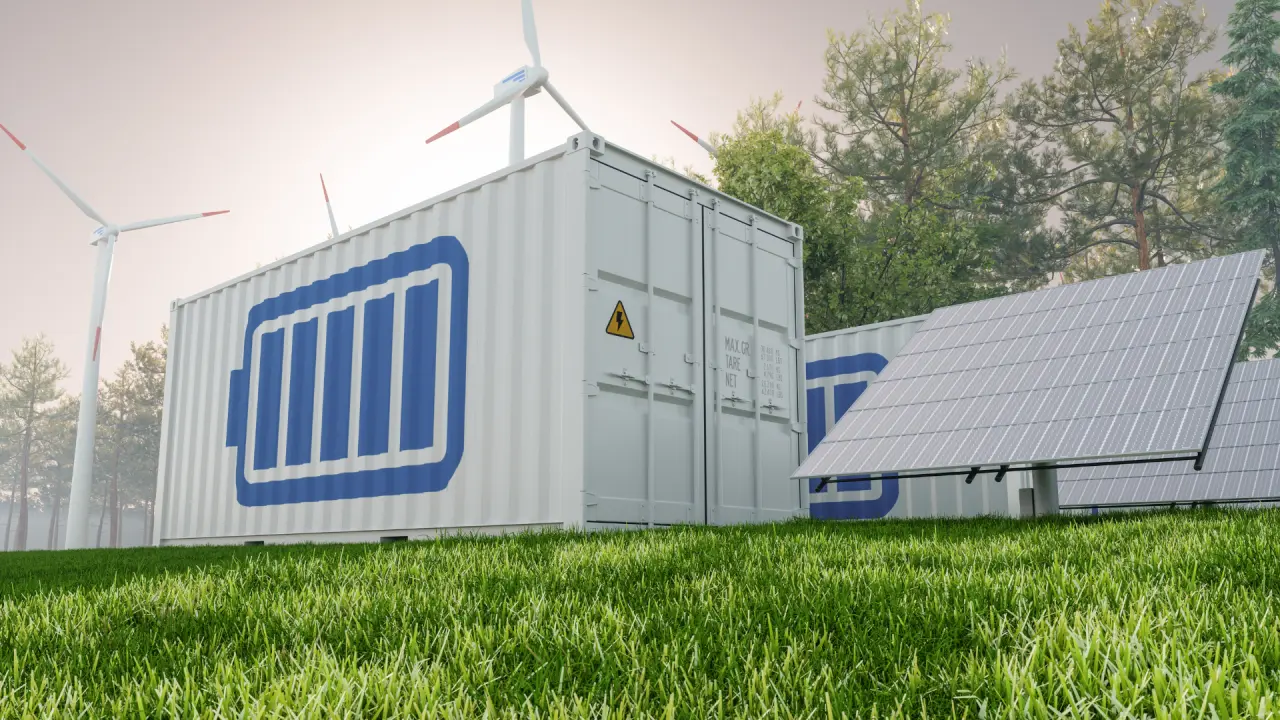
Large-scale battery storage systems are large-format battery systems with high capacity, usually in the MWh range, that can store electrical energy. Technologically, they often consist of containers full of lithium-ion battery modules, sometimes combined with other storage technologies (e.g., redox flow). Such systems achieve efficiency rates of over 90% and can deliver their full power within seconds. This speed and efficiency makes BESS a joker in energy supply – they step in when the power grid needs relief or additional energy.
The benefit for grid stability is enormous: Battery storage systems already make important contributions to stabilizing frequency and voltage in the power grid. They can serve as a buffer to absorb load peaks and balance generation fluctuations. Excess solar power at midday, for example, is temporarily stored and released again in the evening when demand is high. In this way, large-scale storage systems reduce the need for reserve power plants and prevent wind turbines or PV systems from being curtailed. Renewable electricity becomes usable around the clock, which helps to accommodate more affordable solar and wind power in the system.
In addition to grid-supporting tasks (such as primary and secondary control power), BESS also enables business models for operators: they buy electricity at low or even negative prices and sell it at higher prices when demand is high. As a result, large batteries now finance themselves without feed-in tariffs or other subsidies. Research institutions such as the Karlsruhe Institute of Technology (KIT) are working on further optimizing such storage systems. In view of increasingly decentralized and fluctuating energy generation from renewable sources, building storage capacity for grid stabilization is a central challenge that should be met with cost-efficient large-scale storage solutions. In short: Large-scale battery storage systems are highly modern battery systems that can flexibly absorb and release electricity – a key to making the power grid of the future stable and renewable.
Why Lease Land for Battery Storage?
For owners of open spaces – for example, unused meadows, former industrial areas, or low-yield agricultural land – leasing to a battery storage operator can be extremely profitable. Compared to traditional agricultural use or other leasing models, significantly higher revenues are possible. Lease prices of 20,000 to 30,000 € per hectare per year are no longer uncommon in the market, as current offers from project developers show. This is many times higher than what can be achieved with leasing for agriculture (often only a few hundred euros per hectare) or even for PV open spaces. This high willingness to pay reflects the value of strategically located areas for operators: a suitable location can significantly reduce project costs, with part of the savings being passed on to the owner as rent.
Advantages Over Other Uses of Your Land at a Glance:
-
High Income: As mentioned, battery storage leases are significantly higher than, for example, agricultural leases. Farmers benefit from five-figure euro amounts per hectare annually that can be achieved. This makes leasing for BESS one of the most profitable options for open spaces.
-
Long-term, Secure Payment: Typical contract terms of 20 to 30 years provide a reliable, predictable source of income. The lessee (investor/operator) is usually an energy-experienced company, which means stability and low default risk. Leases are often paid semi-annually or annually in advance.
-
No Effort for the Owner: The investor takes care of planning, construction, and operation of the battery storage facility. As a lessor, you only provide the land and don't need to worry about anything else. Maintenance, insurance, and operational management are completely handled by the operator. This eliminates the workload that would be incurred with self-management or other uses.
-
Land Remains Your Property: You don't sell the land, but only make it available for a limited time. After the end of the contract (or if the project is not realized), the land reverts to you. Modern battery storage systems are built in containers – after the end of use, the facility can be removed without residue and the land recultivated. The substance of your soil remains preserved.
-
Contribution to the Energy Transition: By providing your land for large-scale storage, you enable the expansion of renewable energies. You actively contribute to climate protection, as large batteries make solar and wind power more efficient and stabilize the grid. This commitment also brings idealistic benefits and a positive image as an environmentally conscious property owner.
How Much Lease for Battery Storage Land
Which Areas are Suitable? Battery storage requires less space than solar parks, for example, but there are certain requirements. Project developers preferably look for areas between approximately 0.5 and 3 hectares in size. Much smaller areas can be leased too: in commercial zones, a few hundred square meters are enough for a smaller storage system. Important is the location in the immediate vicinity of a transformer station or high-voltage line (110 kV/380 kV). The closer the grid connection point, the lower the grid connection costs – which increases the lease offers. Ideal are properties that are at most a few hundred meters to a few kilometers away from the nearest suitable transformer station. Bavaria offers good conditions here, as the power grid is densely developed and many regions already have transformer stations.
Level, easily accessible areas are also preferred. A connection via a road or access for construction vehicles should be available. Also, the property should be outside nature reserves or flood zones, as such restrictions can make projects more difficult. Conversion areas (e.g., former landfills, military sites) or already sealed commercial areas are particularly attractive because they usually have fewer approval hurdles. But agricultural land is also accepted – especially those with low soil value or yield, where a solar or storage project can be economically more sensible than the previous use.
Earning Potential: How high can the lease actually be? This of course depends on the factors mentioned (location, area, market situation). Currently, lease payments in the range of 20,000–30,000 € per hectare/year can be achieved in Germany, sometimes even more. For comparison: For open-space solar systems, leases are typically 3,500–4,000 €/ha, and classic arable land leases often under 500 €/ha. So one can see the enormous potential for increase. These high amounts are possible because a large-scale storage system can create a lot of value on a small area – the operators generate revenues in the electricity market and through grid services. Part of this flows back to the landowner as rent, so that both sides benefit.
If your site meets these criteria, the next step is concrete: on the page lease your land for battery storage you can check in seconds whether your parcel sits close enough to the grid for a large-scale storage system, free of charge and without leaving any contact details. The page also sets out the lease ranges by grid proximity and the path to a non-binding lease offer.
Solar park lease also possible?
Not every site is close enough to the grid for a battery storage system. If that applies to you, a solar park is often the better option: ground-mounted photovoltaics reaches a market-typical €3,000 to €5,000 per hectare and year, up to €5,500 at grid-near premium sites. Whether your parcel qualifies is shown in the overview of how to lease land for photovoltaics, and the guide to photovoltaic lease prices sets out the current figures.
Checklist for Property Owners
Is your land suitable for a battery storage system? The following checklist helps you assess your property and optimally prepare for leasing:
-
Minimum Size & Layout: Ideal are contiguous areas of about 0.5 to 3 ha. On larger areas, for example, combined PV-battery parks can also be realized. In commercial zones, a few hundred square meters are enough for a smaller storage system. The layout should be practical (preferably rectangular, no elongated strips).
-
Proximity to the Power Grid: A key criterion! Is there a transformer station (110 kV or more) within a radius of ~1-2 km? Or does a high-voltage line pass directly by the property? The closer and more powerful the grid connection point, the more attractive the area. Check on the map where the nearest transformer stations are. In Bavaria, for example, there are many suitable locations along the medium and high-voltage grids.
-
Accessibility: Is there an access option for construction vehicles (trucks, cranes, etc.)? A paved path to the property is optimal. If not, the project developer could create access, but this must be plannable. Level terrain without steep slopes and with load-bearing soil greatly facilitates construction.
-
Planning Law Status: Is the area in the outer zone (i.e., outside a development plan)? This is often the case with open spaces. The outer zone is not automatically excluded, but requires a building permit and possibly the establishment of a development plan (more on this below). If the area is already designated as a commercial or industrial zone, all the better – then battery storage systems are often directly permissible.
-
No Exclusion Criteria: Make sure that the property is not in protected areas (landscape protection, nature conservation, FFH area, etc.) and does not harbor protected biotopes. Such factors must be checked by the project developer, but you can recognize obvious exclusions in advance with the help of the ENLAPA Land Check. A storage project is relatively environmentally friendly (no emissions, little noise), but authorities pay attention to site compatibility.
If you can largely check off these points, chances are good that your area is suitable for battery storage. Next Step: Make your area known and get offers. Feel free to use our marketplace – list your area online for free to receive non-binding lease offers from project developers. Through the platform, you can create an exposé with just a few clicks ("List Area and Get Lease Offers") and thus directly approach investors. The more attractive your property is (location, grid connection, available area, etc.), the higher the chance of a top offer.
Lease Agreements for Battery Storage
Once you have found an interested party, it's time for contract design. Lease agreements for battery storage have some special features, as they are long-term commercial leases. The following contract contents and conditions are typical:
-
Term and Extension: Common are long-term durations of 20 years, with the option to extend by, for example, 5-10 years. This gives the operator planning security and you long-term income. Pay attention to whether the contract provides for automatic extension or whether new negotiations are required.
-
Staging of Lease Payments: Often, a retention fee is paid from the time of contract conclusion until the storage system goes into operation (e.g., annually 1,000 €/ha of the planned capacity as compensation for providing the area during the development phase). As soon as the storage system is running, the regular lease payment takes effect – for example, a fixed sum per hectare and year. Industry standard are payments in advance and often indexed (linked to an inflation index) to maintain the monetary value over the decades. According to experts, operational leases in the order of 2.00-3.00 € per m² and year are currently common (which corresponds to 20,000-30,000 €/ha), in individual cases even more, depending on the project. Important: Secure all payments through a bank guarantee, so that you are financially protected even in the worst case (insolvency of the lessee).
-
Contract Conditions in Case of Delay: Since large projects sometimes require approval time, milestones should be defined in the contract. For example: If the building permit is not granted within 3 years or construction does not begin within 2 years after approval, you have a special right of termination. This way, you avoid your area being blocked endlessly if the project is not implemented.
-
Land Register Entry and Transfer of Ownership: Usually, the lessee requires a easement in the land register (e.g., right of use for the term). This should be limited in time (to the contract duration) and clearly regulate what happens when the contract ends. Agree on compensation if the easement is transferred to third parties or must be deleted prematurely. Your consent as owner should be required for a contract transfer to a new operator – so you retain control over who is ultimately the lessee.
-
Obligations of the Lessee: Have it stated in the contract that the investor obtains all necessary permits and erects and operates the facility according to regulations. In addition, he should take out liability insurance and be liable for any damages, e.g., to your property or neighboring properties. If, for example, drainages are damaged or field damage occurs during the construction phase, the lessee must pay for it. The traffic safety obligation on the fenced site also transfers to him.
-
Dismantling and End of Lease: Be sure to agree that after the end of the lease, the dismantling of the facility is taken over by the operator and the area is restored to its original condition (including removal of foundations, cables, etc.). A deposit or guarantee for dismantling costs is recommended. You should also receive a right of termination if the operation of the storage system is permanently discontinued or the lessee becomes insolvent, so that you can get your area back in such cases.
-
Cost Assumption: It is customary for the lessee to bear all costs associated with the lease – e.g., notary and land registry costs, surveying costs, as well as, if necessary, your expenses for legal advice. This should be stated in the contract so that you do not end up with ancillary costs.
Given the complexity of such contracts, it is advisable to seek expert advice. Have the contract reviewed by a notary or lawyer, ideally someone with experience in PV or BESS lease agreements. This ensures that all eventualities are covered and your interests are preserved. A well-negotiated contract creates clarity for both sides and lays the foundation for a long-term successful partnership.
Technical Terms: MW, MWh, Storage Duration and Netzbooster
Anyone talking to project developers about a large-scale battery storage system encounters a few technical terms that are easy to place. Megawatts (MW) is the power at which the storage system charges or discharges, megawatt-hours (MWh) the amount of energy stored. The ratio of the two gives the storage duration: a 2-hour system with 20 MW has 40 MWh of capacity. Power is decisive for the grid connection, while land requirements depend on the number of battery containers and thus on capacity.
Netzbooster (grid boosters) are very large storage systems of the transmission system operators that hold reserve power so that existing extra-high-voltage lines can be loaded more heavily. They stand at the grid operators' substations and are not developed through lease offers to private owners. The enquiries that reach landowners almost always concern market-driven large-scale storage on the high- or medium-voltage grid. For systems with around 10 to 20 MW, their land requirement is in the order of 0.5 to 1 hectare, depending on storage duration, battery generation and the required fire-safety distances.
Planning Law, Permits and Grid Connection
Besides grid proximity, planning law decides whether storage can be built. Free-standing large-scale storage is privileged in the Außenbereich (undesignated outer zone) under Section 35 of the Federal Building Code only in narrow constellations, for instance in a spatial and functional connection with an existing wind or solar plant. In most cases the municipality draws up a Bebauungsplan (development plan), or the storage is built in a designated commercial or industrial zone. A permit under the Federal Immission Control Act (BImSchG) is generally not required for lithium-ion storage, but a building permit is, in which noise protection under the TA Lärm, the fire-safety concept, distances and, where applicable, water-law conditions are examined.
For the grid connection, the project developer submits a grid connection request to the grid operator, which checks grid compatibility and reserves capacity. For providing the capacity, the grid operator can demand a Baukostenzuschuss (construction cost contribution); this is paid by the operator as the connecting party, not by the owner. The operator runs and pays for all procedures, which should be stated explicitly in the lease agreement. Whether your parcel meets the hard site criteria can be seen in advance in the free ENLAPA land check.
Lease per Megawatt, Payment Mode and Taxes
Project developers calculate the lease for large-scale storage per project and often according to installed power in megawatts, because the storage system creates a lot of value on a small area. For comparability, offers are converted into euros per hectare or per square metre; that is where the quoted ranges come from. The norm is an annual, index-linked lease with a lower reservation fee during the development phase. One-off payments for the entire term are the exception and should be weighed against the present value of the running lease and the tax effect. Lease income is subject to income tax; the basics are explained in the article on taxes when leasing for photovoltaics.
Conclusion
Leasing land for large-scale battery storage can be a win-win situation, especially for Bavarian property owners – attractive lease income and active support for the energy transition go hand in hand. It is important to check the suitability of the property in advance and carefully clarify all framework conditions. Feel free to use our offer: With the free Solar Area Check on Enlapa, you can find out within seconds whether your area is basically suitable for an energy storage system (or solar park). Check your property now and take a step closer to profitable leasing!