


Battery Storage in Germany 2026: Size Distribution, Voltage Levels, and the Dead Valley Between 30 and 50 MW
As of: 11 July 2026 · Data source: Marktstammdatenregister (MaStR), © Bundesnetzagentur (DL-DE/BY-2.0)
Battery storage is the growth story of Germany's energy transition — and the public narrative is dominated by the "gigawatt battery" headline. The German market master data register (MaStR) tells a more precise story: the fleet consists overwhelmingly of tiny units, the utility-scale business plays out at the medium-voltage level — and between 30 and 50 MW there is a striking gap, a "dead valley" that only the project pipeline leaps over again. This piece analyses the complete MaStR storage dataset and ties the numbers to the regulatory framework that explains the distribution.
Data basis
- Plant, not single device: MaStR lists individual units, not whole plants. A 300-MW battery consists of many individual units at the same grid connection point. We group them per connection point into a single storage system and sum the gross capacity.
- Analysed: 11,236 storage units in total, of which 65 were excluded by name as pumped storage. This leaves 9,702 operating battery storage systems (4.46 GW) and 1,185 planned storage systems (11.64 GW).
The base: tens of thousands of home and commercial batteries
The lion's share of the fleet is small units. 9,218 of the 9,702 operating battery storage systems are below 1 MW — home and commercial batteries. By voltage level:
- 5,539 storage systems < 1 MW at low voltage (LV, 0.4 kV) — the classic PV home battery.
- 742 storage systems < 1 MW at medium voltage (MV) — larger commercial and neighbourhood storage.
They dominate the count but barely the capacity. For the energy industry — and for the grid — the interesting story only begins above 1 MW.
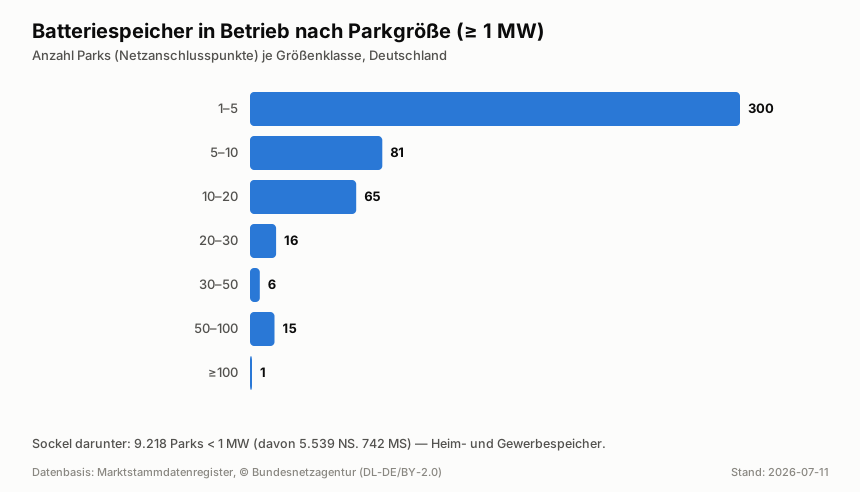
Above 1 MW the fleet thins out quickly: 300 storage systems in the 1–5 MW class, 81 between 5 and 10 MW, 65 between 10 and 20 MW — and only 16 storage systems between 20 and 30 MW.
Medium voltage is the workhorse
Strip out the tiny units and medium voltage is the dominant tier of utility-scale storage. Of the 208 MV storage systems of at least 1 MW, the median is 2.8 MW, the 90th percentile is 12 MW, and the maximum at medium voltage is 30 MW — the Worms battery. Notably, a cluster of identical projects appears: nine storage systems between 20 and 21 MW, including three identical 20.7-MW plants at medium voltage (Diespeck, Iphofen, Karstädt).
The following cross-tab shows the real logic of the market: as capacity grows, projects climb to higher voltage levels. Small storage sits at LV and MV, large storage at HV and extra-high voltage.
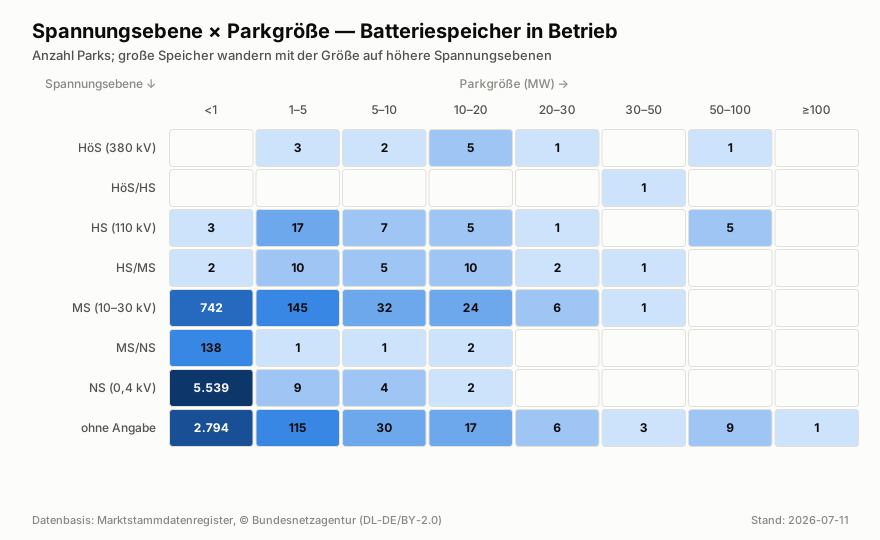
The boundary is sharp:
- At medium voltage the world effectively ends at 30 MW (Worms). Exactly one MV storage system reaches the 30-MW mark.
- The mixed tier HV/MV reaches 32 MW (SMAREG6 Gunzenhausen).
- Above 50 MW medium voltage disappears entirely: of the 16 storage systems at or above 50 MW, six have a recorded voltage level — and all six connect at 110 kV or higher (high / extra-high voltage), none at medium voltage. For the other ten (almost all built in 2025/2026), no voltage level is recorded in the register yet.
The largest operating battery is Batteriespeicher Westfalen 1 in Hamm at 174 MW, followed by Neurath (99 MW, 110 kV) and Metelen (92.5 MW).
The dead valley between 30 and 50 MW
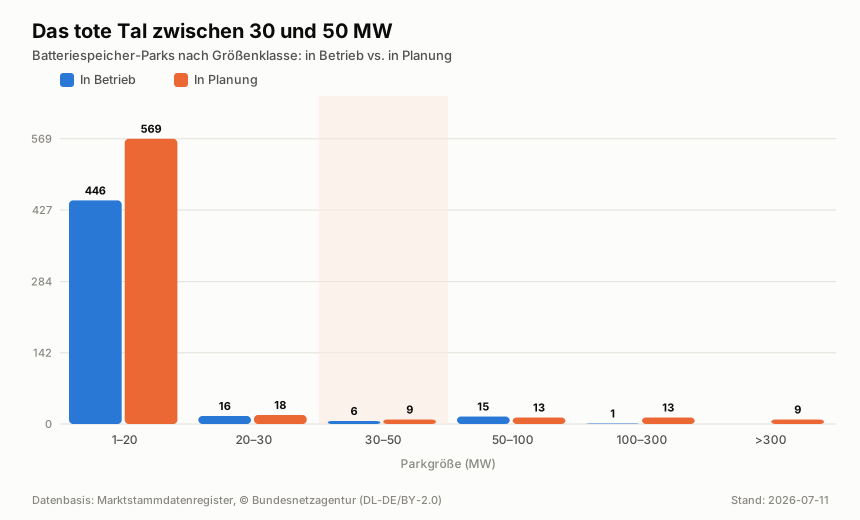
The most remarkable finding: in the 30–50 MW class there are only six operating battery storage systems nationwide — and one of them is a boundary case. Batteriespeicher-Park Worms sits at exactly 30.0 MW on the class's lower edge: it is the same project that marks the medium-voltage maximum in the previous section — the proof of the MV ceiling, not a resident of the valley. Strictly above 30 MW, five storage systems remain in all of Germany:
| Storage | Capacity | Voltage level | Location |
|---|---|---|---|
| BESS Jardelund | 48.0 MW | EHV/HV | Jardelund |
| Batteriespeicher Emsland | 45.0 MW | not stated | Lingen |
| Beilrode II – BESS – CoLocation | 44.7 MW | not stated | Beilrode |
| BESS Balzhausen 2 | 38.3 MW | not stated | Balzhausen |
| SMAREG6 Gunzenhausen | 32.0 MW | HV/MV | Gunzenhausen |
| Batteriespeicher-Park Worms* | 30.0 MW | MV | Worms |
* Boundary case: at exactly 30.0 MW, Worms marks the upper end of medium voltage, see above.
Below 30 MW the market clusters (16 storage systems at 20–30 MW, dozens below); above 50 MW it picks up again (15 storage systems at 50–100 MW) — in between: a valley. Why? The answer lies less in the technology than in grid connection and regulation (see below).
The valley becomes even clearer next to the project pipeline: what is planned today skips the 30–50-MW class and barbells into two size regimes.
The pipeline: a barbell, not a bell curve
1,185 battery storage systems totalling 11.64 GW are in planning — more than double the 4.46 GW installed today. The distribution is a classic barbell:
- 569 storage systems in the 1–20 MW range (the decentralised mass market),
- 18 storage systems at 20–30 MW and 9 storage systems at 30–50 MW (the narrow valley stays narrow),
- 22 storage systems at or above 100 MW, including 9 giga-projects of 300 MW or more totalling 5.84 GW.
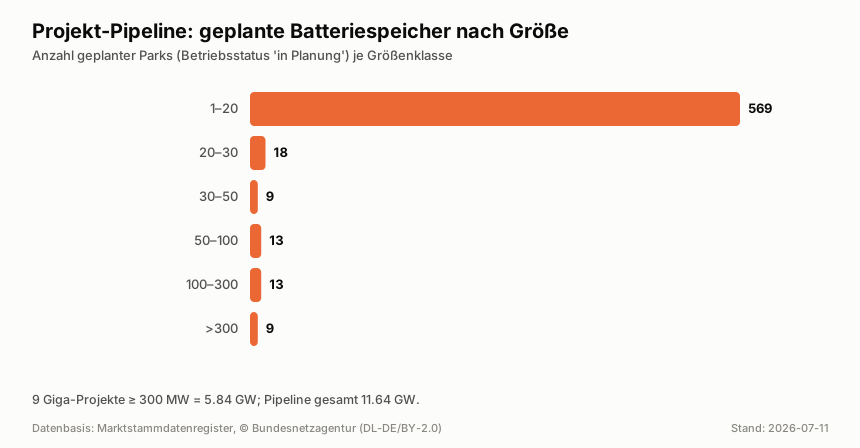
At the top sit four GigaBattery projects at former lignite sites (Jänschwalde, Boxberg, Lippendorf) at 1,000 MW each, plus Batteriespeicher Westfalen 3 in Hamm (538 MW). The pipeline confirms the pattern of the installed base: either small and decentralised or very large at the transmission grid — the middle is avoided.
Why the dead valley? Grid connection, TAB and BKZ
The gap between 30 and 50 MW is not a coincidence; it follows the grid connection logic.
1. Voltage level follows capacity (VDE-AR-N 4110 / 4120, RfG). The technical connection rules define at what capacity a plant connects at which level. VDE-AR-N 4110 (medium-voltage TCR) applies to plants from 135 kW on grids of >1 kV to <60 kV and replaced the old BDEW medium-voltage guideline; VDE-AR-N 4120 (high-voltage TCR) governs connection to the 110-kV grid. Both nationally implement the European network code "Requirements for Generators" (RfG, (EU) 2016/631). In practice, a single MV feeder or busbar has a limited hosting capacity (indicative values of a few MVA per feeder, roughly 15–20 MVA at the busbar) — a 30-MW project scrapes that limit, a 40-MW project blows past it. The jump to 110 kV thus becomes technically unavoidable somewhere around 30–50 MW.
2. The 110-kV connection is expensive — and the construction subsidy is confirmed. Moving to high voltage means a dedicated substation and a substantial construction subsidy (Baukostenzuschuss, BKZ). On 15 July 2025 the Federal Court of Justice (EnVR 1/24) ruled that grid operators may charge grid-coupled battery storage a BKZ calculated under the performance-price model (Leistungspreismodell) — the subsidy has a "steering and control function" because the connection gets more expensive as power demand rises. (The underlying case concerned a 1,725-kW battery; the court expressly did not rule on storage above 100 MW at HV/EHV.) For projects at the threshold this means the 110-kV connection raises project cost in a step change — a further incentive to either stay small below the MV limit or build large enough that the substation pays off.
3. The grid-fee exemption until 2029 rewards fast, large builds. Under § 118(6) EnWG new electricity storage is exempt from grid fees for 20 years, provided it is commissioned by 4 August 2029. This window favours large, quickly realised projects at the transmission grid — and explains the pipeline's giga-projects. Whether the exemption survives beyond that is regulatorily open.
Taken together, these three factors produce exactly the observed barbell: below the MV hosting limit the connection is cheap and fast; above it a dedicated substation only pays off at large capacity. The valley in between is the most expensive, least economic zone.
What this means for project developers
- The 30-MW medium-voltage limit is real. Anyone planning without a 110-kV connection should check the specific grid operator's MV hosting capacity early — it decides feasibility and timeline.
- Between 30 and 50 MW lies the economics cliff. A project in this band already bears the full 110-kV connection cost (substation + performance-price BKZ) but spreads it over comparatively little capacity. Staying below or going well above is usually the better math.
- Site and connection point decide the BKZ. Since the subsidy follows the target level's performance price, it varies strongly by operator and voltage tier — a siting criterion that can be quantified before securing the land.
The ENLAPA platform links MaStR base data with grid-operator, voltage-level and redispatch information to make exactly these questions — hosting limit, connection cost, nearby competition — answerable per site early on.
Offering your land for battery storage
For landowners these figures come down to one rule: the value of a site is decided at the grid connection, not by solar irradiation. Whether your parcel sits close enough to a substation or a 110-kV line is shown in seconds on the page lease land for battery storage and check suitability. Grid-near sites reach a market-typical €20,000 to €30,000 per hectare and year.
Solar park lease also possible?
Not every site is close enough to the grid for a battery storage system. If that applies to you, a solar park is often the better option: ground-mounted photovoltaics reaches a market-typical €3,000 to €5,000 per hectare and year, up to €5,500 at grid-near premium sites. Whether your parcel qualifies is shown in the overview of how to lease land for photovoltaics, and the guide to photovoltaic lease prices sets out the current figures.
Frequently asked questions about battery storage in Germany
Sources
Data: MaStR complete data export, snapshot 11 July 2026, © Bundesnetzagentur, Data Licence Germany – Attribution 2.0 (marktstammdatenregister.de).
Regulation:
- Federal Court of Justice, decision of 15 July 2025, EnVR 1/24 — construction subsidy for battery storage (performance-price model): press release
- VDE-AR-N 4110 (medium-voltage TCR): vde.com/fnn
- VDE-AR-N 4120 (high-voltage TCR): vde.com/fnn
- Network Code "Requirements for Generators" (RfG), (EU) 2016/631: EUR-Lex
- § 118(6) EnWG (grid-fee exemption for storage): gesetze-im-internet.de