


Agri-PV Disadvantages 2026: What Landowners Need to Know
Agrivoltaics promises the best of both worlds: solar power AND continued farming on the same land. For you as a landowner, however, dual use comes with tangible disadvantages that are rarely discussed openly — above all a lease roughly one-third lower than a classic ground-mounted solar park (typically €1,000–3,000/ha instead of €3,000–5,000/ha per year), higher cost per kilowatt-hour generated, and noticeably more work in day-to-day farming. This article walks through the main agri-PV disadvantages from a lessor's perspective — and when classic ground-mounted PV is the better choice for your land.
Key facts at a glance
Lower lease income: Agri-PV typically brings €1,000–3,000 per hectare per year — about one-third less than a classic solar park (€3,000–5,000/ha, up to €5,500 in premium locations), because roughly one-third less electricity is generated per hectare.
More expensive electricity: According to a 2024 Fraunhofer analysis, power from agri-PV systems costs about twice as much as from conventional ground-mounted solar parks — so fewer developers actively search for agri-PV land.
More work: Farming between module rows is slower, machine working widths must fit, and every pass carries a risk of damaging the installation.
Biodiversity: Contrary to intuition, a classic solar park with extensive grassland usually supports species diversity more than continued intensive farming under agri-PV.
Our recommendation: Choose agri-PV only when a classic solar park cannot be permitted or the land remains indispensable for your farm. Whether the higher-paying classic option works on your land, the free ENLAPA area check tells you in seconds.
"Check in 10 seconds — no email, no callback"
Disadvantage 1: About one-third less lease income than a classic solar park
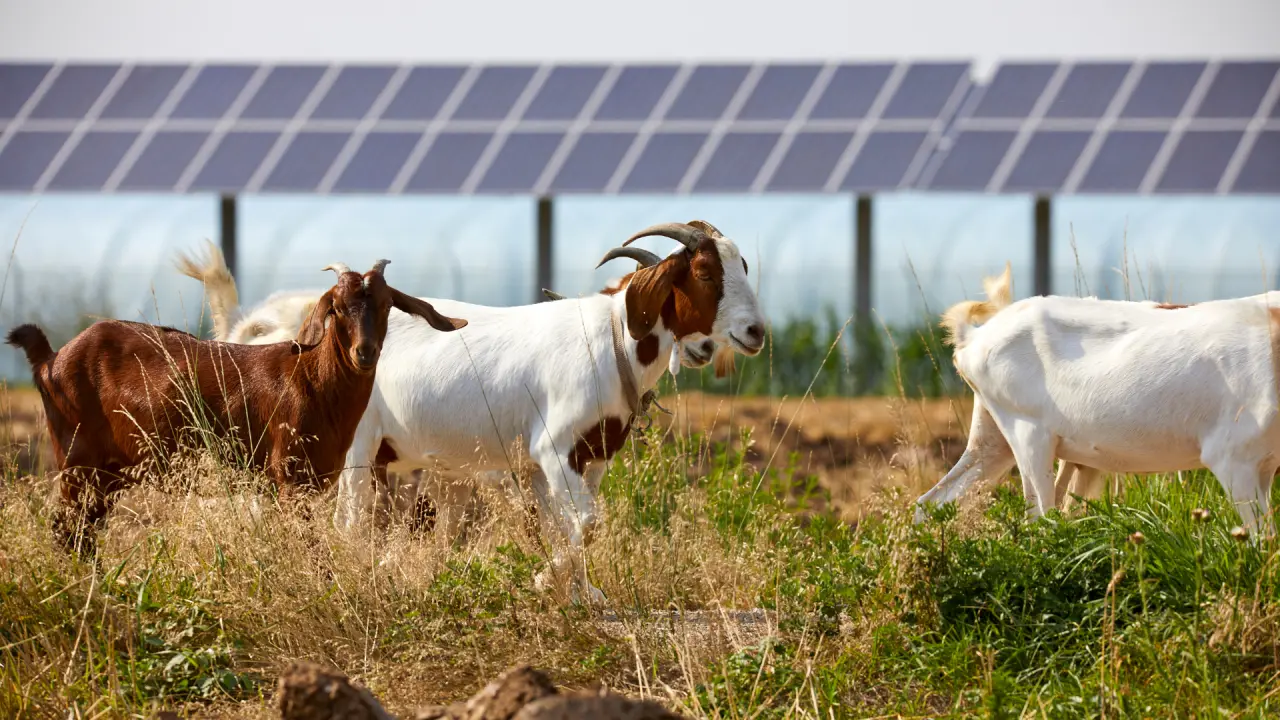
The disadvantage that matters most to lessors first: agri-PV pays less. Because the modules are mounted higher or spaced further apart to allow farming beneath or between them, roughly one-third less module capacity fits on the same hectare — and correspondingly less electricity revenue, out of which the operator pays your lease. In practice, agri-PV lease offers typically range from €1,000–3,000 per hectare per year, while classic ground-mounted solar parks bring €3,000–5,000/ha in 2026, up to roughly €5,500 in premium grid-close locations. The full ranges and their price drivers are covered in Photovoltaic Lease Prices 2026.
The continued farming income usually does not close that gap — especially since crop yields under the modules also decline depending on the crop (more below). Bottom line: with dual use, owners typically end up with less total income than with a pure solar lease, for considerably more work. For context: even the lower agri-PV lease is still a multiple of standard arable rent, which averages around €350/ha — just far less than the same land would earn as a classic solar park.
Disadvantage 2: More expensive electricity — and thus fewer interested developers
Agri-PV plants need custom elevated or vertical mounting structures, more land per kilowatt, and more complex planning. According to a 2024 Fraunhofer analysis, electricity from agri-PV systems was therefore about twice as expensive as electricity from conventional ground-mounted solar parks. If you lease out your land, those investment costs are the operator's risk, not yours — but they still reach you indirectly: fewer project developers actively search for agri-PV land, demand for your plot is smaller, and the lease offered is correspondingly lower. For the rare cases where owners want to invest themselves, the cost disadvantage applies directly: high upfront investment, longer payback, greater dependence on power prices and subsidy rules.
Disadvantage 3: More laborious farming and damage risk
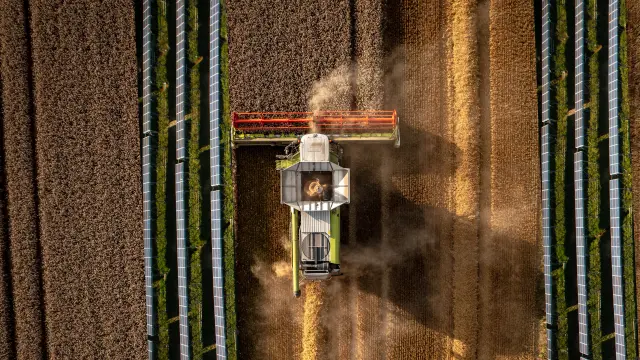
Farming beneath or between module rows is slower: machine working widths must match the layout, turning maneuvers become more frequent, and every pass carries the risk of damaging mounting structures or modules — with the liability questions that follow. As field work becomes increasingly automated over the coming decades, the fixed module geometry can become an additional constraint. Maintenance and operation of the plant itself are also more demanding than for a classic solar park, which weighs on the operator's running costs — and in turn on the room for your lease.
Disadvantage 4: Shading cuts the yields of light-hungry crops
Module shading is a real yield factor depending on the crop: corn, soy, and field beans are particularly sensitive to light deficiency and can deliver noticeably lower yields. Running agri-PV often means switching the crop rotation to more shade-tolerant cultures. In hot, dry years partial shading can even benefit some crops — but that is not plannable, and changing varieties is a real intervention in your operation.
Disadvantage 5: Biodiversity — the underestimated comparison
Intuitively, "farming plus solar" sounds more ecological than "solar only." In practice it is usually the other way around: with a classic ground-mounted solar park, intensive farming is replaced by extensive grassland — with measurably positive effects on insects, soil life, and species diversity, as our guide Solar Parks and Biodiversity shows. Under agri-PV, intensive use continues and this biodiversity gain is largely lost. In addition, agri-PV needs more land for the same power output, which changes the landscape more visibly and can strain local acceptance.
Disadvantage 6: More complex permitting and open legal questions
Agri-PV projects go through the same planning stages as classic solar parks — but must additionally demonstrate continued agricultural use (see DIN SPEC 91434), and a number of subsidy and classification questions remain unresolved. Our guide on Agri-PV: open legal questions on permitting covers the details. For you as an owner, this mainly means longer and less certain project timelines until the first lease payment.
What about classic ground-mounted PV? It has disadvantages too
A fair comparison includes the other side — a classic solar park is not effortless either:
-
The land leaves active cultivation: For 20–40 years, the field becomes an energy site (with extensive care or sheep grazing). If your farm needs the land, you cannot use it twice.
-
Permitting is not guaranteed: Not every plot falls within the eligible-area map, and the municipality must support the zoning process — the criteria are explained in Ground-Mounted PV Approval.
-
Long lead times: From grid connection request to construction start usually takes years — regardless of classic or agri.
-
Visual impact and acceptance: A solar park changes the landscape; involving the municipality and greening the perimeter are mandatory, not optional.
Note, however, that these points apply equally or more strongly to agri-PV (more land per kilowatt, more complex permitting) — they argue for careful planning, not for dual use as such.
When is agri-PV still the right choice?
Our recommendation as a marketplace has been consistent for years — agri-PV makes sense for owners in exactly two situations:
-
A classic solar park cannot be permitted on your land — for example, because the municipality only supports dual use or the land is protected for agricultural structure. Then agri-PV is the only route to a solar lease.
-
You absolutely need to keep the land in your farming operation and cannot lease replacement plots. Then dual use secures both cultivation AND additional income.
In all other cases, a classic lease — whether arable land or meadow and grassland — usually brings more income for less effort and risk.
The first step is the same either way: finding out what is possible on your land at all. The ENLAPA area check screens protected areas, zoning, and rough grid proximity in seconds — free of charge and without providing any personal data.
What you can do right now as a landowner
-
Check your land: Use the free area check to find out in seconds whether your land fundamentally qualifies for a classic solar park — only if that is ruled out does agri-PV become the first option.
-
Never rely on a single offer: Get comparison offers — spreads between developers are wide, especially for agri-PV.
-
Think about the grid connection request early: Grid operators process requests in order of arrival; in one case we documented, an application sat at position 99 in the queue, behind requests totaling 4,753 MW — around eight months of waiting. Every month of hesitation delays your first lease payment. The full process is explained in Building a Solar Park 2026.
-
Calibrate lease expectations: €1,000–3,000/ha for agri-PV, €3,000–5,000/ha for a classic park — anyone promising you far more should be able to substantiate it.
Frequently asked questions
Conclusion
Agri-PV is a sensible niche solution — but not the first choice for most landowners. Roughly one-third less lease income, electricity about twice as expensive, more laborious farming, and a smaller biodiversity gain generally favor the classic ground-mounted solar park, provided it can be permitted on your land. Check that now in seconds with the free ENLAPA area check — or list your land on our marketplace and receive no-obligation lease offers from project developers, for classic PV and agri-PV alike. How the leasing process works in detail is covered in Lease Land for a Solar Park.