


Photovoltaic Lifespan 2026: What the 25–40 Years Mean for Your Lease
When you lease your land for a solar park, you are not leasing it for a few years, you are leasing it for a generation. Photovoltaic modules are designed for 25 to 40 years of operation, and lease agreement base terms are built directly around that lifespan. For you as the landowner, technical lifespan is not a footnote for engineers, it is the foundation for the questions that matter most in your contract: how long does it run, what happens at the end, and how does it affect the lease? This article translates the technical facts about lifespan into what actually counts for your land.
"Check in 10 seconds — no email, no callback"
Key Takeaways
Photovoltaic modules last 25 to 40 years, with performance degradation of only 0.15–0.5% per year.
Lease agreements are built around this lifespan: a 20-year base term, extendable to 30–40 years.
Ground-mounted photovoltaics earns €3,000–5,000 lease per hectare per year (up to €5,500 at top sites); a grid-near battery storage site earns €20,000–30,000 per hectare.
The most underestimated time sink is the grid connection request — the earlier it is filed, the less waiting time you lose at the start of your lease term.
How long does a photovoltaic system actually last?
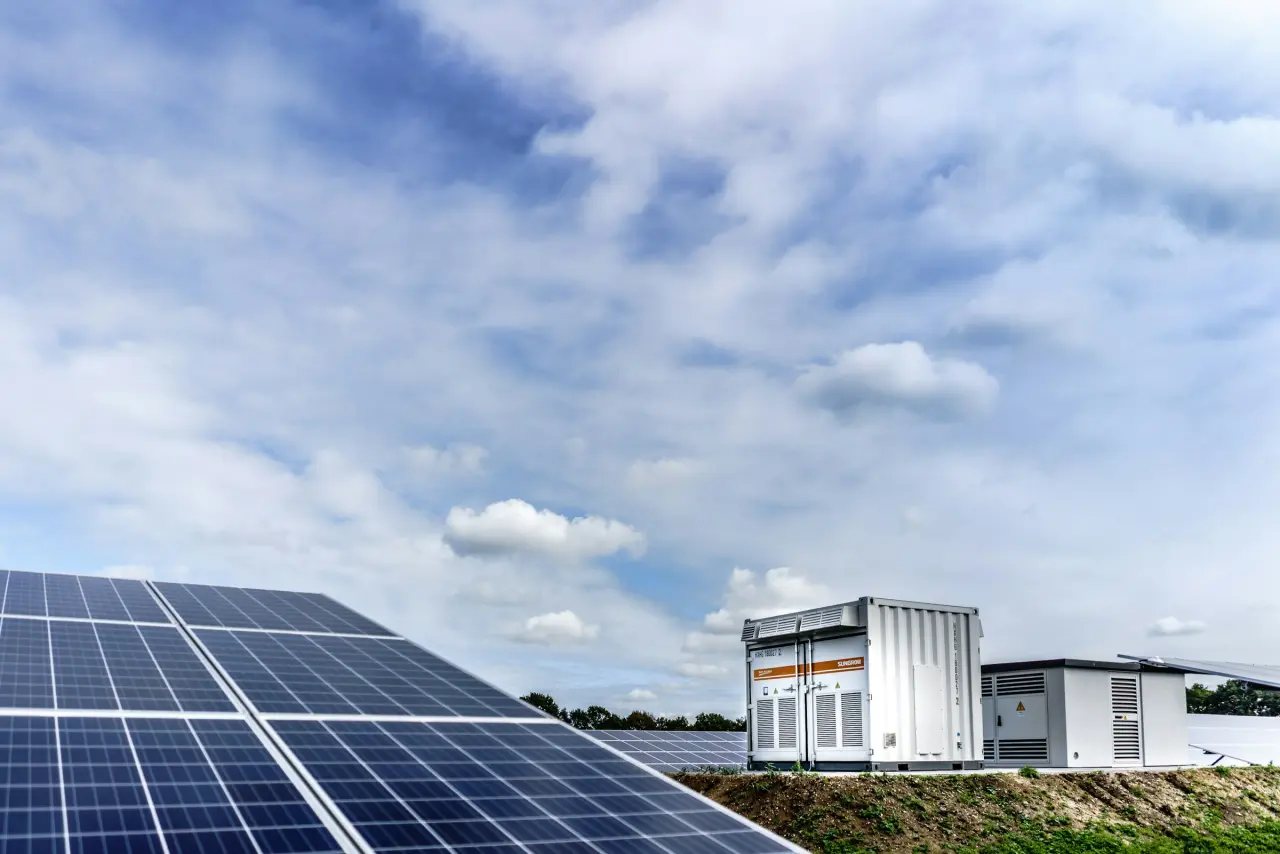
The average life expectancy of modern photovoltaic modules today ranges between 20 and 40 years, with high-quality crystalline modules at the upper end of that range. The decisive factor is so-called degradation: a natural, annual performance loss averaging 0.15 to 0.5 percent. According to the Fraunhofer Institute, that means: after 20 to 25 years, a module typically still delivers around 80 to 90 percent of its original output, still enough for economically viable operation.
Not every component of the plant lasts equally long. The table below shows which parts are typically replaced during the lease term, important to know because that replacement is the operator's business, not yours as the lessor:
| Component | Typical lifespan | Consequence for operation |
|---|---|---|
| Solar modules | 25–40 years | Usually stay in service for the entire lease term |
| Inverters | ~15 years | Typically replaced once during the term |
| Battery storage (hybrid systems) | 15–25 years (4,000–5,000 charge cycles) | Replacement depends on usage intensity |
| Mounting structure and cabling | often outlasts the modules | Needs regular inspection for corrosion |
These figures concern the operator's technology, but they matter to you as the landowner too: they explain why operators are willing to commit contractually for 20 years and longer in the first place, and why a well-built plant is nowhere near the end of its life after 20 years.
Why lifespan determines the term of your lease agreement
Solar park lease agreements almost always follow the same logic: a base term of 20 years, aligned with Germany's 20-year EEG feed-in tariff, with extension options that can bring the total term to 30 to 40 years. That is no coincidence, it follows directly from the technical lifespan of the modules: only if a plant can economically produce electricity for that long does the operator's investment in grid connection, permitting and construction pay off.
For you, that means two things. First, a long lease term is normal and not a warning sign, on the contrary, it is the basis for reliable lease income that is predictable for decades. Second, precisely because the commitment is so long, it is worth taking a close look at the contract details, especially indexation and dismantling, more on that in the guide to the Photovoltaic Lease Agreement.
Repowering or dismantling: what happens at the end of the term?
When the base term ends and no extension applies, there are two paths. With repowering, the old, degraded modules are replaced with new, more powerful ones, the land stays in the operator's portfolio, and you continue to receive lease payments, usually on renegotiated terms. With dismantling, the entire plant is removed and the land is restored to its original condition.
Which path is ultimately chosen does not need to be decided today, but the obligation to do so must be in the contract. Pay particular attention to:
- a contractually fixed dismantling obligation that requires the operator to fully remove the plant,
- a dismantling bond or reserve, so the costs do not fall on you as the owner if in doubt,
- a clear rule on whether and under what conditions repowering is possible at the end of the term.
What lifespan means for the amount of your lease
The long, technically secured usage period is one of the reasons why ground-mounted photovoltaics earns so much more lease than conventional farmland in the first place. In 2026, lease prices for solar parks typically range between €3,000 and €5,000 per hectare per year, up to €5,500 at grid-near top sites. You will find the full overview by site quality in the guide Photovoltaic Lease Prices 2026.
If your land is especially close to a substation or a high-voltage line, a battery storage system (BESS) may be an option instead of or in addition to a solar park. The lease there is considerably higher, usually between €20,000 and €30,000 per hectare per year, because a large-scale storage system can extract more value on a small area through the electricity market and grid services. Details in the guide Leasing Land for Large-Scale Battery Storage.
The underestimated time sink: the grid connection request
However long a plant's lifespan is, there is one step at the start of the project timeline that could be resolved faster than it usually is in practice: the grid connection request. Grid operators fundamentally process incoming requests in the order they are received. In a grid operator's response to a real grid connection request that we received in July 2026, the request sat at position 99 of the queue, behind requests totalling 4,753 megawatts of registered capacity.
For you as the owner, that means: the earlier the grid request is filed, the less of that waiting time is lost from the 20 to 40 years of your contract before any lease actually starts flowing. If the request is only filed after a lease agreement is signed, that waiting time is added on top of the remaining project timeline. Raise this actively with a developer, filing an early grid request is non-binding and free of charge for you in terms of power of attorney and application.
Is your land suitable? The free area check
Before the question of term, dismantling or lease amount becomes relevant at all, it must be clear whether your land qualifies in the first place. The ENLAPA Area Check checks protected areas, spatial planning and the rough grid situation of your land in seconds, free of charge and without you leaving any personal data. It does not replace an in-depth technical and legal review by a project developer, but it gives you an immediate, reliable first assessment instead of waiting weeks for a manual response.
For more on the basic requirements a plot needs for a solar park, see the overview Lease Land for a Solar Park or Lease Land for Photovoltaics.
Frequently Asked Questions
Conclusion
The lifespan of a photovoltaic system is more than a technical footnote, it is the reason lease agreements run for 20 years and longer and why solar parks can offer such reliable lease income in the first place. What matters to you as the landowner in the end is that dismantling and indexation are secured in the contract, and that the grid connection request is filed early enough not to lose time off your 20- to 40-year lease term. Check your land now for free with the ENLAPA Area Check or list your land to collect non-binding offers from project developers.