


Agricultural Lease Agreement 2026: Rights, Obligations and Termination
The German agricultural lease (Landpachtvertrag) is governed by §§ 585 ff. BGB and differs from an ordinary tenancy in several important respects: longer notice periods, a duty to notify the authorities, and the tenant's right to take the proceeds of the land. This guide sets out what belongs in an agricultural lease, which deadlines apply, and what landowners in particular should watch for.
Key Takeaways
- Contracts running more than two years require text form (§ 585a BGB), otherwise the contract counts as concluded for an indefinite period. The notice itself requires the stricter written form (§ 594f BGB).
- For open-ended contracts the notice period of § 594a BGB applies: notice by the third working day of a lease year, effective at the end of the following lease year.
- Conclusion generally has to be notified to the authority within one month under the Landpachtverkehrsgesetz.
- The tenant may not unilaterally change the type of use. Solar use requires the owner's consent.
- Sale does not break lease: selling the land does not end the lease (§ 593b BGB).
- Typical terms: 9–12 years for farming, 20–30 years for solar projects.
"Check in 10 seconds, no email, no callback"
If you would like to look at solar use rather than agricultural leasing: lease arable land for solar sets out the conditions for cropland, and lease meadow and grassland for solar those for permanent grassland. Current ranges are shown in the overview of photovoltaic lease prices.

Lease or tenancy: the decisive difference
A tenancy agreement grants only the use of an object. A lease goes further: it also grants the right to take the fruits and proceeds. For agricultural land the lease is therefore always the correct contract type, because the tenant farms the land and keeps the harvest.
The Landpachtvertrag is a specifically regulated special case of the lease. It is governed by §§ 585 ff. BGB, with numerous particularities that do not exist in general tenancy and lease law.
Text form: when it is mandatory
Under § 585a BGB, an agricultural lease requires text form (Textform) if it is concluded for longer than two years (since 1 January 2025; before that, written form applied). Text form means a legible declaration on a durable medium that names the person making it, so an email or an unsigned PDF is enough. If text form is not observed, the contract is not void. It is then treated as concluded for an indefinite period.
Do not confuse the two: a notice of termination of an agricultural lease still requires the stricter written form (Schriftform) of § 594f BGB, i.e. a document signed by hand. A notice given by email is invalid.
In practice this is the most common and most expensive mistake. Parties who agree verbally on twelve years legally hold an open-ended contract that can be terminated under the deadlines of § 594a BGB. The intended long commitment, which both sides have planned around economically, falls away entirely.
What belongs in every agricultural lease
These points should not be missing from any contract:
- Parties: full names and addresses of landowner and tenant.
- Leased object: cadastral district (Gemarkung), Flur, parcel number and size in hectares, ideally with a cadastral map attached. Imprecise area details are a frequent source of dispute.
- Term: start and end, definition of the lease year (often 1 October to 30 September), any extension options.
- Rent: amount per hectare per year, due date, payment method, and an index clause to keep pace with price developments.
- Type of use: which farming is permitted, and that any change requires consent.
- Maintenance and cultivation duties: proper cultivation, preservation of soil fertility, handling of tracks, ditches and drainage.
- Public charges: who bears contributions, levies and apportionments.
- Subsidy and payment entitlements: allocation of agricultural support. Without a clear rule, disputes are likely.
- Description of the leased land under § 585b BGB: the documented condition at handover, so that at return it can be shown what has changed.
- Return of the land: condition of the land at the end of the contract.
- Termination provisions: ordinary and extraordinary termination.
- Signatures of both parties: legally, text form has sufficed since 2025; in practice a document signed by both sides remains the safest evidence.
Term, extension and termination
Fixed-term or open-ended
A fixed-term agricultural lease ends on expiry, and ordinary termination is generally excluded. In farming, terms of 9 to 12 years are common, sometimes 5 to 6 years.
An open-ended contract runs until one side gives notice.
The notice period under § 594a BGB
Open-ended agricultural leases carry a deadline that is routinely underestimated: notice must be given by the third working day of a lease year and then takes effect at the end of the following lease year.
In practice that means a lead time of up to two years. Anyone wanting to use their land differently at short notice generally cannot. This deadline is precisely why owners considering solar use should start planning early.
How that period is calculated in an individual case, which formal errors make a notice invalid, and what a termination agreement with the tenant looks like is set out in detail in the guide terminating an agricultural lease.
Extraordinary termination for good cause
Alongside ordinary termination, § 594e BGB permits termination without notice for good cause, where continuation of the lease cannot reasonably be expected of the terminating party. The main candidates are:
- substantial payment arrears on the tenant's side,
- persistently non-compliant cultivation, for example damage to soil fertility or neglected drainage,
- unauthorised transfer of use to third parties after a prior warning.
What is not sufficient is the mere wish to use the land differently. Anyone hoping to free up land for a solar project will not get there via extraordinary termination.
Continuation of the lease
When a contract expires, continuation can be demanded under certain conditions if termination would represent undue hardship for the tenant. This is not an automatic extension. It must be agreed contractually or enforced in court.
Sale, inheritance and right of first refusal
Sale does not break lease
If the leased land is sold, the lease does not end. Via § 593b BGB the rules on a change of owner in tenancy law apply accordingly: the buyer steps into the running contract with all rights and obligations.
The same conclusion follows for both sides. A sale is not a way to shed an unwanted lease. And anyone buying land in order to develop an energy project there must know the remaining term and the notice periods of the existing lease before the purchase. This is one of the most common reasons why apparently finished projects are set back by years.
Death of the tenant
When the tenant dies the contract does not end automatically, it passes to the heirs. § 594d BGB gives both sides a special right of termination: heirs and landowner may terminate within one month of learning of the death, on six months' notice to the end of a calendar quarter; for both sides this right is subject to no further condition. The heirs may, however, object to the landowner's notice and demand continuation of the lease where proper cultivation by them appears assured (in text form, no later than three months before the lease would end).
Right of first refusal
There is no general statutory right of first refusal for the tenant over the leased land. It arises only through an express agreement or through registration in the land register. This must be kept apart from the settlement right of first refusal under the Reichssiedlungsgesetz, which belongs to the settlement company and not to the tenant.
Notification under the Landpachtverkehrsgesetz
The conclusion of an agricultural lease generally has to be notified to the competent authority within one month. The authority reviews the contract and may object under certain conditions, for example where the rent is disproportionately high or the distribution of land use is deemed unsound.
Responsibility, thresholds and exemptions are regulated differently in each federal state. When in doubt, ask your district or local agricultural authority.
Rent, due date and adjustment
Rent is normally agreed per hectare per year. The due date deserves a close look: without a deviating provision, the rent is payable under § 587 BGB only at the end of the lease year. That is unfavourable for landowners, which is why in practice a fixed payment date or payment in instalments is almost always agreed.
If the circumstances decisive for setting the rent have changed permanently, an adjustment can be demanded under § 593 BGB, at the earliest two years after the start of the contract or after the last adjustment.
Because that route is cumbersome, a contractual index clause linking the rent to a published index is advisable. Over long terms this is decisive, so that the rent does not lose real value.
Determining the local customary rent
The local customary rent is the rent actually paid for comparable land in a comparable location. Reliable reference points are:
- the lease price surveys of the statistical offices of the federal states and the Federal Statistical Office,
- the chambers of agriculture, which maintain regional overviews,
- the valuation committees for land values at district level.
The figures vary strongly by region. As a rough frame, arable land sits at around 350 euros per hectare per year and grassland at 200 to 300 euros. Concrete figures and the regional picture are covered in the guide Lease Prices for Arable Land.
Who pays what: taxes, levies and subsidies
Three items regularly cause disputes because they are missing from the contract:
- Property tax. The debtor towards the municipality is the owner. Passing it on to the tenant is possible and widespread in farming, but it has to be agreed.
- Contributions to water and soil associations and agricultural accident insurance contributions. Same logic, same need for a clear provision.
- Payment entitlements and direct payments. They go to whoever actually farms the land, so to the tenant. Because they have a value of their own, the contract must govern what happens to them when the lease ends.
A fourth point concerns game damage: liability under the Bundesjagdgesetz sits with the hunting cooperative or the hunting tenant, not with the landowner of the leased plot. The party entitled to compensation is the person farming the land. What matters are the short registration deadlines with the municipality, which are frequently missed in practice.
Special case solar: change of use requires consent
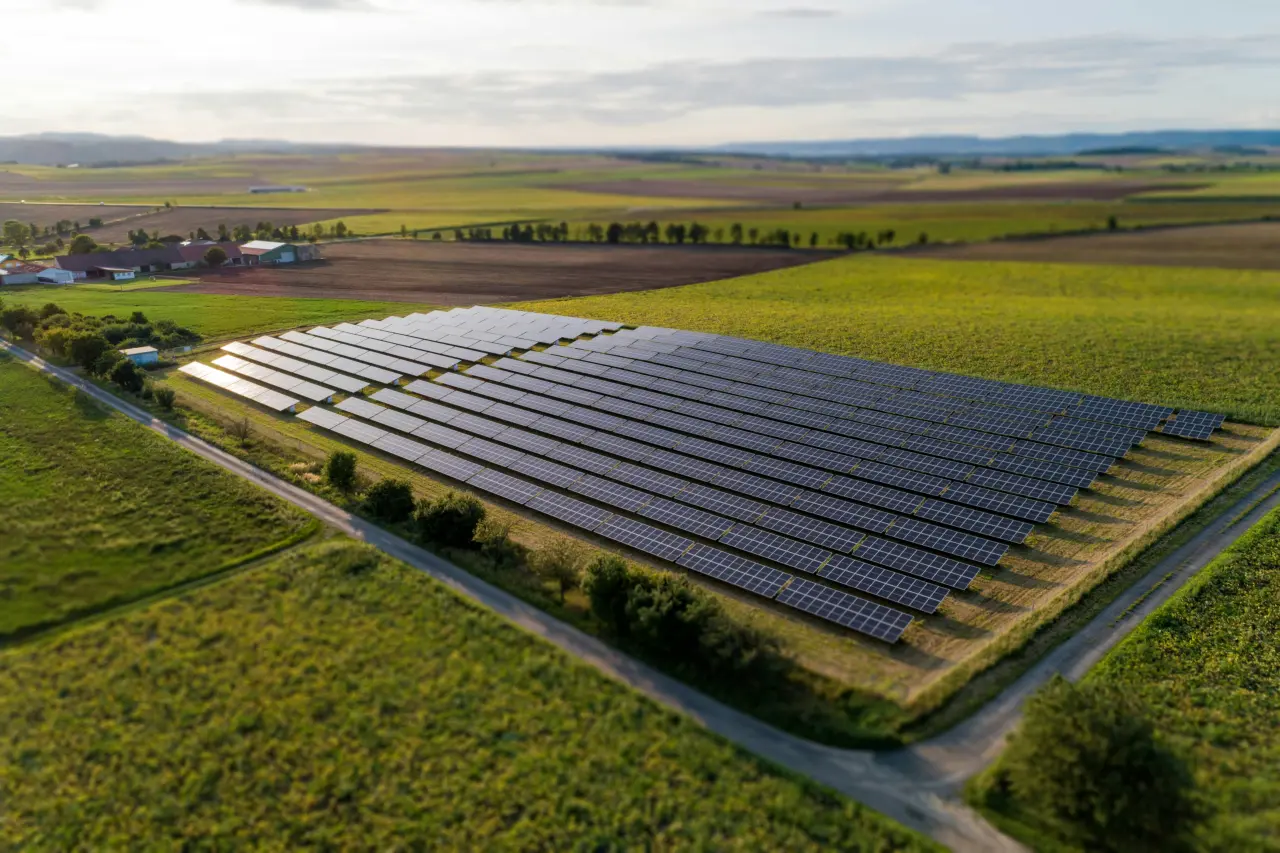
The tenant may not unilaterally change the agreed type of use. Converting arable land into a solar park is exactly such a change of use, and it requires the owner's consent. In addition, § 589 BGB applies: the tenant may not hand over use to a third party without permission either, so cannot pass land on to a developer independently.
For owners this is the decisive message: you decide whether your land is available for a solar project, even while it is leased. Conversely, a running agricultural lease with a long remaining term is a real obstacle to a solar project, because the operator needs the land free.
The usual route out of a running contract is therefore not termination but a mutual termination agreement, often combined with a settlement payment to the tenant. Economically that is normally viable, because a solar rent is a multiple of the agricultural rent.
Lease contracts for solar projects themselves work fundamentally differently from the classic agricultural lease: 20 to 30 years instead of 9 to 12, security via a restricted personal easement in the land register, a decommissioning obligation backed by security, plus provisions on rights of way and cable routes. The details are covered in the guide Photovoltaic Lease Agreement, and current conditions in Photovoltaic Lease Prices 2026.
Whether your land qualifies for a solar project at all can be checked free of charge and without registration. The check takes around ten seconds and shows grid connection, protected areas and eligibility.
Common mistakes in agricultural leases
- Verbal agreements beyond two years: the contract becomes open-ended and the intended commitment falls away.
- Imprecise description of the land: without Gemarkung, Flur and parcel number it is unclear in a dispute what was actually leased.
- No description of the leased land at handover: the initial condition can no longer be proven at return.
- No index clause: over 12 years a fixed rent loses noticeable purchasing power.
- Due date not regulated: the statutory rule of payment at the end of the lease year applies.
- Subsidy entitlements left unregulated: a regular source of conflict at the end of the contract.
- Forgetting to notify the authority: with consequences depending on the federal state.
- No provision on change of use: creates uncertainty as soon as solar or storage use comes up.
- Remaining term not checked when buying land: sale does not break lease, and the project is delayed by years.
Frequently Asked Questions on the agricultural lease
This article provides a general overview of German agricultural lease law and does not constitute legal advice. The Landpachtverkehrsgesetz is additionally implemented differently by each federal state. Have your specific contract reviewed by a lawyer before signing.