


Renting out your roof for solar: what your roof space earns in 2026
Renting out a roof for solar in Germany usually pays off from around 500 to 1,000 square metres of contiguous, unshaded roof area. You make the roof available for typically 20 years or more, and an investor builds and operates the system at its own expense. In return you receive a lump sum (around 15 to 25 euros per square metre is realistic for larger roofs), an annual lease or a free roof renovation. What your roof is actually worth depends on orientation, structural capacity, roof condition and the grid connection.
"Check in 10 seconds — no email, no callback"
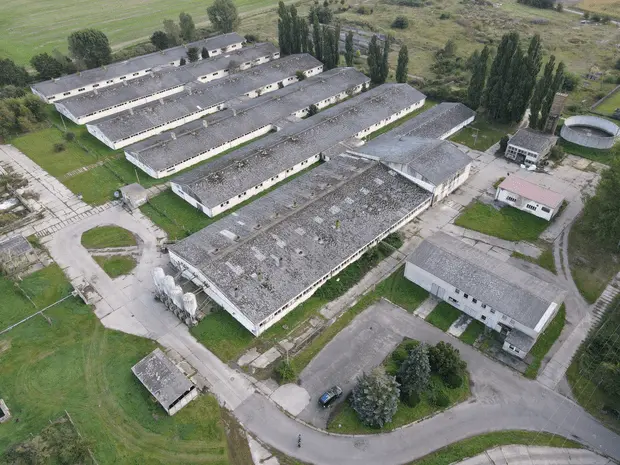
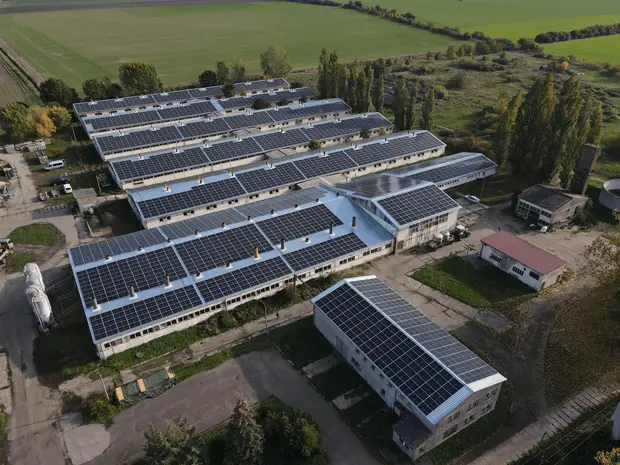
Example of an agricultural roof before and after renovation and installation of a solar system.
Key points at a glance
Investors usually only rent roofs from 500 to 1,000 m². As a rule of thumb, 1 kWp needs about 5 m² of roof.
Three payment models: lump sum (larger roofs around €15–25/m²), annual lease (usually a low single-digit euro amount per m² per year) or free roof renovation. After 20 years, a 5–10% share of revenue is often offered.
Asbestos roofs may not be fitted with panels; they must be renovated first. That makes renovation in exchange for roof use attractive for many farm and hall roofs.
Contracts for more than one year require text form (Section 578(1) in conjunction with Section 550 BGB), and the investor will also ask for an easement in the land register.
The system remains the property of the operator (Section 95 BGB), who bears maintenance, insurance and removal.
Roof systems above 1,000 kWp go through the auction: the average award value in June 2026 was 9.72 ct/kWh.
Renting out roof space: how the model works
When you rent out your roof, you grant an investor or project developer the right to install and operate a solar system on your building. The investor plans the system, applies for the grid connection, finances modules, mounting structure and inverters and sells the electricity. You invest nothing and receive a payment for the use of the area.
Typical roofs are livestock barns and machinery halls, riding arenas, warehouses and commercial halls and large barns. Flat roofs or roofs pitched to the south, east or west without shading from trees, silos or neighbouring buildings are in particular demand. A residential roof is almost always too small for the rental model; an owner-operated system is the usual solution there.
Which roofs are suitable?
| Criterion | What investors look at |
|---|---|
| Size | usually from 500–1,000 m² of contiguous area; 1 kWp needs about 5 m² |
| Orientation and pitch | south, east-west or flat roof; little shading over the day |
| Structural capacity | sufficient load reserve for modules, mounting, snow and wind, confirmed by a structural assessment |
| Roof condition | remaining service life covering the contract term of 20 years or more |
| Covering | no asbestos cement, no installation without prior renovation |
| Grid connection | distance and free capacity at the grid connection point, costs of cable and transfer station |
| Special features | for livestock barns with ridge ventilation, higher module cleaning effort |
Size is only the entry ticket. Whether an offer materialises ultimately depends on the yield per square metre minus the costs of structural measures, grid connection and, where needed, renovation.
What does renting out earn? The three payment models
1. Lump sum
The investor pays an amount for the entire base term, usually 20 years, at contract signing or commissioning. According to C.A.R.M.E.N. e.V., the Bavarian competence centre for renewable raw materials and renewable energy, around 15 to 25 euros per square metre is realistic for larger roofs, with deviations up and down. The amount is discounted, so in total it is usually lower than the sum of annual payments, but it is available immediately and does not depend on the operator's later ability to pay.
2. Annual lease
According to the same assessment, the ongoing lease is usually a low single-digit euro amount per square metre per year. It spreads income over the term and should include indexation so that it does not lose purchasing power over 20 years. A payment per installed kilowatt-peak or a share of electricity revenue is also possible; in that case a minimum lease should be agreed to cushion weak revenue years.
3. Free roof renovation
For roofs in need of renovation, the investor covers the cost of the new roof covering and in return uses the roof for the base term without or with a reduced lease. For many owners of old farm and hall roofs this is the real value of the deal: the renovation would be due anyway, and the new covering remains your property as part of the building.
After 20 years: a share of electricity revenue
If the system keeps running after the base term, a share of around 5 to 10 percent of electricity revenue is often offered, regardless of how the first 20 years were paid. Negotiate this follow-on arrangement up front rather than leaving it open. How long modules actually last is explained in our guide to photovoltaic lifespan.
Worked example: 2,000 m² hall roof
| Assumption | Value |
|---|---|
| Usable roof area | 2,000 m² |
| Installable capacity (rule of thumb 5 m² per kWp) | around 400 kWp |
| Lump sum at €15–25/m² | around €30,000–50,000 |
| Ongoing lease at €1–3/m² per year (assumption in the low single-digit range) | around €2,000–6,000 per year |
| From year 21 | often a 5–10% revenue share |
These figures are a rough guide, not an offer. A roof with major renovation needs, a long route to the grid connection point or a tight structural reserve can come in well below; a well-oriented, newly covered roof with a grid connection on the farm can come in above. Always compare offers on the same basis (square metres of roof or installed kWp).
What the electricity price has to do with your roof lease
The lease is paid from the system's electricity revenue. For roof systems up to 100 kWp, the statutory EEG rates apply, which our guide to feed-in tariffs 2026 lists in detail; from 100 kW the electricity must be marketed directly. Roof systems with more than 1,000 kWp, roughly from 5,000 m² of roof, only receive support through the Federal Network Agency's auction for solar installations of the second segment.
| Auction for roof systems, bid deadline 1 June 2026 | Value |
|---|---|
| Auction volume | 296.3 MW |
| Awards | 108 bids, 208.6 MW |
| Award values | 8.40–10.00 ct/kWh |
| Volume-weighted average | 9.72 ct/kWh |
| Maximum value | 10.00 ct/kWh |
The round was undersubscribed, meaning fewer bids were submitted than volume was offered. For comparison: ground-mounted systems received 4.79 ct/kWh on average in July 2026. The higher value for roofs reflects higher costs per kilowatt (scaffolding, structural work, smaller units), not automatically a higher lease. For your contract, what matters is that the payment is agreed as a fixed amount and does not depend on the later marketing route. The government draft of the EEG 2027 (cabinet decision of 29 July 2026) would restructure support for new systems; it has not yet been passed, and a system already in operation is governed by the legal situation at commissioning.
Renting or leasing the roof? The contract form
Whether the contract is called a rental agreement, lease, roof use agreement or permission agreement is secondary for you. For leases, Section 581(2) BGB largely refers to rental law, so similar rules apply. Three points, however, are not negotiable:
- Text form: A rental agreement for a property or part of a property intended to run for more than one year must be made in text form (Section 578(1) in conjunction with Section 550 BGB). Otherwise it is deemed concluded for an indefinite period and can be terminated with ordinary notice. Since 1 January 2025, text form suffices; written form was required before.
- Easement: Investors and their banks additionally require a limited personal easement in the land register (Section 1090 BGB). It secures the operating right even against a buyer or in a forced sale. Limit it to the roof area and cable routes and agree on its deletion when the contract ends.
- Ownership of the system: The system is only mounted for the duration of the contract and is therefore a temporary fixture under Section 95 BGB. It remains the operator's property, and the operator bears maintenance, insurance and removal.
How a solar lease agreement is structured in detail is shown in our guide to the solar lease agreement.
Asbestos on the roof: renovate first, then install
Many agricultural buildings are covered with asbestos-cement sheets. Under the German Hazardous Substances Ordinance (Annex II No. 1, TRGS 519), these roofs may not be fitted with solar panels: covering, coating and drilling for fixings are prohibited, and no exemption is possible. Only demolition, renovation and maintenance work by specialist companies with the required expertise is permitted.
For the owner this means an asbestos roof is not a reason for exclusion but a negotiating point. If the investor takes over removal, disposal and the new covering, the renovation is the consideration for the roof use. Make sure disposal certificates are handed over to you and that the warranty for the new covering lies with you or is assigned to you.
Checklist: what belongs in the roof use agreement
- Term and extension: base term (usually 20 years), extension options, right of takeover or removal at the end.
- Payment: amount, reference basis (m² or kWp), due date, indexation, minimum lease with a revenue share, payment before construction if planning takes a long time.
- Structure and condition: structural assessment before installation, condition report with photos, liability for damage from installation, operation and removal.
- Roof repairs: who pays for dismantling, storing and reinstalling the system if the roof needs repairs during the term?
- Access: access rights for maintenance with advance notice, rules for livestock, hygiene and fire protection requirements on the farm.
- Insurance: operator liability and system insurance of the operator; notification to your building insurer.
- Removal: complete removal at the operator's expense, secured by a guarantee or reserve.
- Sale, conversion, demolition: rights in the event of a sale of the building, special termination or relocation of the system in the event of conversion, deletion of the easement when the contract ends.
Rent out or build yourself?
Calculated over 20 years, an owner-operated system usually earns significantly more than the roof lease, especially if a large share of the electricity is consumed on the farm, for example for milking equipment, cooling, drying or ventilation. In return you bear investment, financing, operation and the electricity price risk yourself, and the system ties up capital that the business may need elsewhere.
Renting out swaps this return for a predictable payment without own capital and without own effort. It fits particularly well if the roof needs renovating anyway, electricity consumption on the farm is low, or you do not want to take on 20 years of responsibility for a technical installation.
Roof and land: the bigger lever is often in the field
For owners with a farmstead and agricultural land, the roof is rarely the only lever. One hectare of ground-mounted solar carries roughly 1 megawatt-peak, as much as a roof of around 5,000 m², and typically pays 3,000 to 5,000 euros lease per hectare per year in 2026. The ranges and price drivers are explained in our guide to photovoltaic lease prices 2026, and the process of leasing land in our guide to leasing land for solar systems.
Conclusion: what is your roof worth?
A roof from around 500 to 1,000 m² can be rented out for solar. For larger roofs, lump sums of around 15 to 25 euros per square metre are realistic, alternatively an annual lease in the low single-digit euro range per square metre or a free roof renovation. Orientation, structural capacity, roof condition and grid connection are decisive. On the contract side, what counts is text form, an easement limited to the roof, clear rules for roof repairs and secured removal.
If you would like to obtain offers for your roof, list your roof or land and receive offers from vetted project developers. For agricultural land, the free ENLAPA area check shows within seconds from official geodata whether a parcel lies within the EEG area framework, which protected areas it touches and how far the nearest substation is.
Sources: Federal Network Agency (Bundesnetzagentur), results of the auction for solar installations of the second segment for the bid deadline 1 June 2026 (16 July 2026) and for solar installations of the first segment for 1 July 2026 (18 August 2026); C.A.R.M.E.N. e.V. (Julian Müller) in top agrar, "Lohnt es sich, das Stalldach an einen PV-Anlagenbetreiber zu verpachten?" (14 May 2024); German Civil Code (BGB) Sections 95, 550, 566, 578, 581, 1090 (gesetze-im-internet.de, Section 578 as amended by the Fourth Bureaucracy Relief Act, in force since 1 January 2025); Hazardous Substances Ordinance Annex II No. 1 and TRGS 519; Renewable Energy Sources Act; Federal Government, cabinet decision on the EEG 2027 of 29 July 2026. Rule of thumb 5 m² per kWp and ground-mounted lease ranges: ENLAPA market observation. As of 14 October 2026. This article does not replace legal or tax advice.